Argentina’s university crisis continues to deepen amid disputes between the government, Congress, and the judiciary over funding for public universities. Students, professors, and university leaders warn that budget cuts are jeopardizing access to higher education and the functioning of academic institutions.
Denied Rights in Latin America
The conflict over public university funding in Argentina continues to intensify amid disputes between the national government, Congress, and the courts, while millions of students and educators denounce the deterioration of the education system and the failure to implement a law designed to guarantee resources for public universities.
You may also be interested in: Community Kitchens Support Thousands of Families in Argentina Amid Budget Cuts and Rising Hunger
More than two years into the administration of President Javier Milei, the university funding dispute has evolved from a budgetary debate into one of the country’s most significant institutional conflicts.
Argentina’s University Crisis Pits the Government, the Judiciary, and Public Universities Against Each Other
At the center of the controversy is the University Funding Law, approved by the Argentine Congress to secure resources for public universities and restore faculty salaries amid inflation and the economic adjustment policies promoted by the executive branch.
The legislation was initially approved in 2024 with broad legislative support. However, President Milei vetoed it, arguing that the state lacked sufficient resources to finance the spending. Months later, Congress passed the law again. The government vetoed it once more. Ultimately, lawmakers overturned the presidential veto, and the legislation formally entered into force.
Despite this, university rectors, faculty unions, and academic organizations argue that the funds never reached public institutions. According to various academic sectors, the government enacted the law while simultaneously implementing decrees and administrative measures that effectively prevented its practical application.
The Judiciary Steps Into the Conflict
The dispute eventually moved to the courts. In March 2026, federal judges ordered the national government to immediately implement the University Funding Law and transfer pending resources to public universities. The Milei administration responded by appealing to Argentina’s Supreme Court in an effort to block the ruling.
The controversy intensified after the government requested that three Supreme Court justices recuse themselves from the case due to their academic ties to Argentine public universities.
Related Stories:
Lower middle class in Argentina: living day to day in a country where working no longer guarantees stability Argentina maintains high levels of poverty after a decade of economic adjustments and crises Retirees in Argentina: Surviving on Minimum Pensions Amid an Unrelenting Crisis
While legal and political debates continue, the consequences are increasingly being felt throughout the education system. More than two million students are currently enrolled in Argentina’s public universities, representing nearly 80% of the country’s total university population.
For thousands of young people from middle- and lower-income backgrounds, public higher education represents their only opportunity to pursue a university degree. The National Interuniversity Council recently warned that “public university education is not a privilege; it is the only opportunity many young people have to become professionals.”
Declining Budgets and Salaries
Data released by national universities and faculty unions reflects the economic impact on the sector. According to figures presented by university organizations, university budgets have declined by 32% in real terms since 2023, while faculty salaries have lost nearly 29% of their purchasing power in less than two years.
Educational institutions also claim that the government owes approximately 2.5 trillion pesos in budget adjustment funds that, according to university representatives, have already been recognized through judicial decisions.
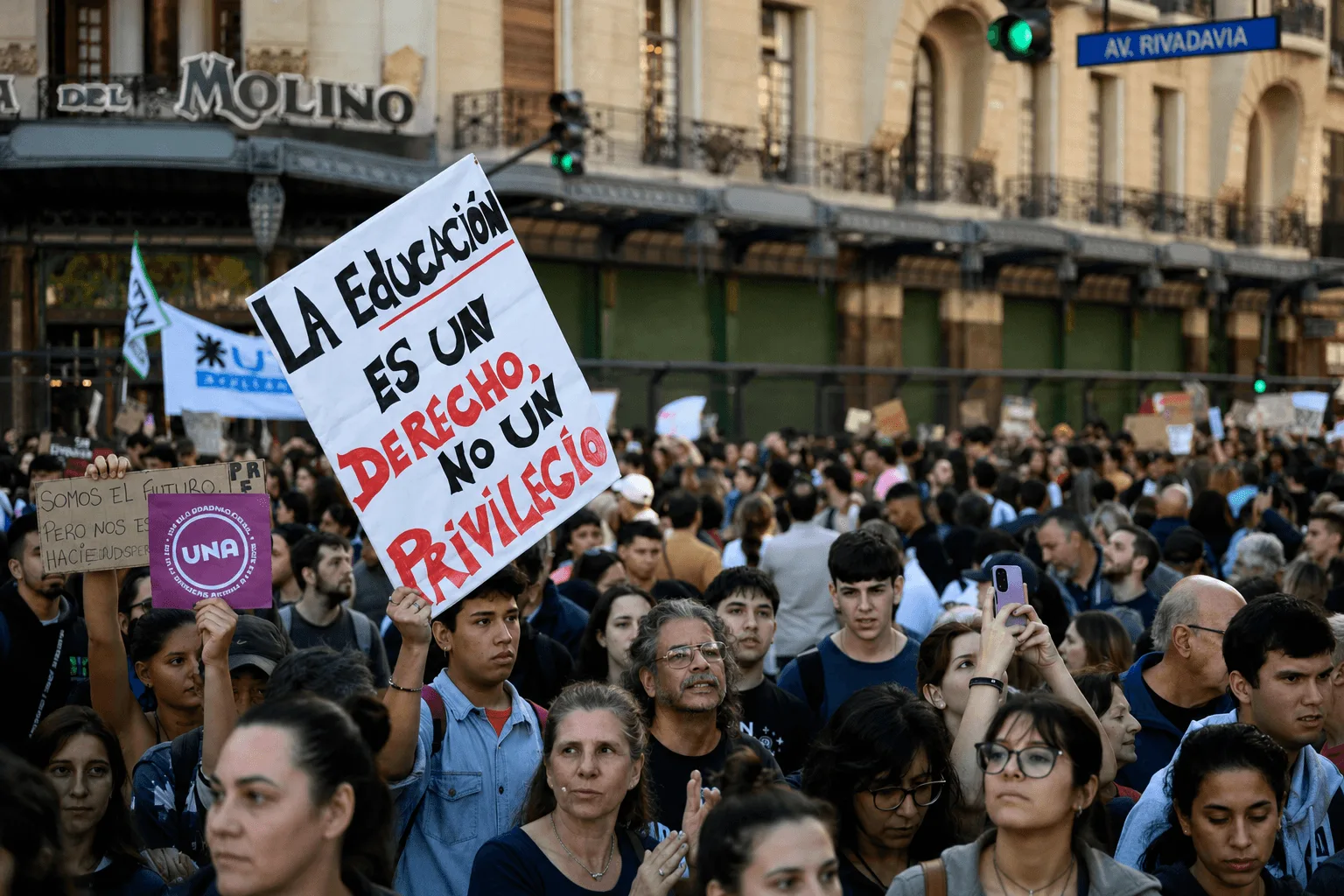
The crisis triggered one of the largest university mobilizations in recent years. On May 12, students, researchers, faculty members, and university staff participated in the fourth Federal University March since Javier Milei took office.
Aerial images of the demonstrations showed major avenues completely filled with protesters outside emblematic institutions such as the University of Buenos Aires, particularly around the Law School and University City campus.
Concerns Over the Impact on Education and Scientific Research
During the demonstrations, faculty unions and student organizations argued that the economic adjustment is affecting not only salaries and infrastructure but also the daily operation of laboratories, university hospitals, scientific research programs, and student scholarship systems.
The National Federation of University Professors stated in several public communications that universities are “facing a critical situation that threatens both the right to higher education and the country’s scientific development.”
Meanwhile, the Argentine University Federation argued that underfunding is “slowly emptying public universities” and warned that several institutions are struggling to cover basic expenses related to utilities, building maintenance, and academic activities.
The Debate Continues
The conflict has also sparked a broader discussion about the role of the state in public education. For experts and international organizations, the debate extends beyond budgetary concerns and is directly linked to fundamental rights.
UNESCO has repeatedly emphasized in its reports that higher education is a human right and an essential tool for reducing economic and social inequalities.
You may also be interested in: Promises and results of Javier Milei’s government in Argentina: health, education, and the economy under debate
In Argentina, where free public university education has historically been considered one of the country's strongest symbols of social mobility, budget cuts have raised growing concerns among academics, researchers, and university administrators.
Sociologist and education analyst Guillermo Jaim Etcheverry recently warned that “the deterioration of universities affects not only current students; it also impacts the training of doctors, engineers, scientists, and teachers that the country will need in the future.”
From the national government, Cabinet Chief Manuel Adorni has defended the administration’s position, arguing that the state “does not have unlimited resources” and that Congress must explain where the funding required to fully implement the law would come from.
As university protests continue in cities across Argentina, students and professors insist that the conflict is no longer solely about economics. Instead, they argue, it has become a broader debate about access to public higher education amid the country’s ongoing fiscal crisis.
In the following video, learn about the key factors behind this crisis and its potential consequences.