Argentina’s lower-middle class is facing growing economic pressure: working no longer guarantees stability, and every price increase reduces the ability to make ends meet.
The economic stability that for decades defined Argentina’s middle class is showing signs of erosion. In thousands of households across the country, an increasingly common scene repeats itself: before heading to work, families check their phones and find new reports of rising prices. Food costs go up, public transportation fares are adjusted again, rents continue to climb, and private healthcare fees increase once more. Amid this chain of price hikes, one recurring question becomes more frequent: how to survive today on an average income.
For millions of Argentinians who belong to the so-called lower-middle class, daily life has become a constant exercise in financial balancing. This is not necessarily a case of extreme poverty or absolute deprivation, but rather a continuous strain on household budgets that affects basic areas such as food, housing, transportation, and access to healthcare.
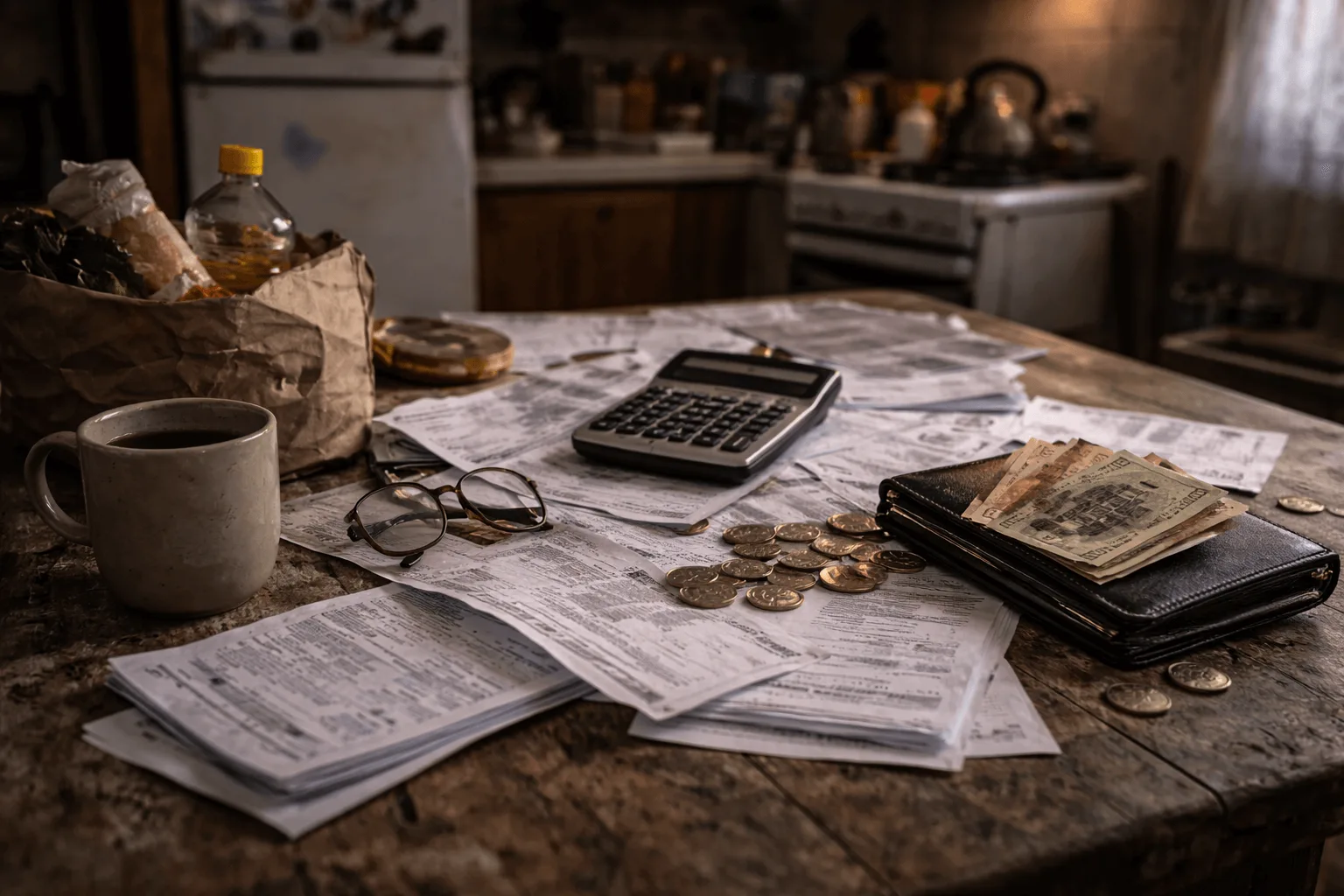
Estimates from private consulting firms cited by the Center for Metropolitan Studies indicate that up to 68% of a typical household’s income may be spent on essential expenses such as food, utilities, rent, and transportation. The remaining margin, in many cases, is reduced to a minimal fraction that barely covers unexpected costs.
You may be interested in: Argentina maintains high poverty levels after a decade of economic adjustments and crises
“The lower-middle class lives in a state of permanent fragility,” explains Lucía Cholakian Herrera, a researcher at the Center for the Implementation of Public Policies for Equity and Growth. According to the expert, this social segment occupies a particularly vulnerable position within the economic structure. “It is not completely excluded from the system, but any economic shock—a devaluation, a rise in tariffs, or job loss—can quickly push it into poverty,” she notes.
In cities such as Buenos Aires, Córdoba, and Rosario, this fragility is reflected in everyday household decisions. Families adjust consumption however they can: switching brands for cheaper products, postponing home repairs, and reducing or eliminating expenses once considered normal, such as vacations or recreational activities.
“We used to buy new clothes for the kids every winter. Now we fix what they already have,” says María Laura González, a 39-year-old administrative employee living in Greater Buenos Aires. Her husband works as a maintenance technician, and together they support a family of four.
“We both have formal jobs, but we’re constantly doing the math. If rent goes up or electricity increases, the entire budget falls apart,” she explains.
This pattern repeats across thousands of households where income is sufficient—but only just. Saving becomes a rare luxury, and any unexpected expense—a car repair, a health issue, or an unanticipated increase in utility rates—can completely destabilize family finances.
Economist Daniel Schteingart, director of the productive development area at Fundar, argues that the structure of household spending in Argentina has become increasingly rigid.
“When most income is spent covering basic needs, consumption stops being a free choice and becomes strategic,” he explains. “Families compare prices, look for promotions, buy in installments, or visit multiple supermarkets to find discounts.”
One of the factors placing the greatest pressure on lower-middle-class budgets is the rise in essential services. Although some official indicators have shown periods of slowing inflation, several basic services have recorded increases above the general average.
Data from the National Institute of Statistics and Census indicate that over the past year, utility rates such as electricity, gas, water, and transportation rose nearly ten percentage points above average inflation.
For sociologist Agustín Salvia, director of the Argentine Social Debt Observatory, this phenomenon particularly affects the most vulnerable middle sectors.
“Lower-middle-class families do not qualify for many state assistance programs, but they also do not have sufficient income to absorb sharp increases in tariffs or services,” he explains. “They are left in a kind of gray zone within the social protection system.”
The paradox of this social segment is that most of its members have formal or semi-formal employment. They work in administrative roles, commerce, technical services, or semi-professional activities.
However, that work no longer guarantees social mobility.
A survey conducted by the Argentine Social Debt Observatory indicates that six out of ten lower-middle-class individuals believe their jobs only allow them to survive, without offering real opportunities for economic progress.
“We work more than ever, but we feel like we’re getting a little worse every year,” says Javier Roldán, a 45-year-old salesperson at an electronics chain in Rosario. “We used to dream of buying a house. Now the goal is simply to make it to the end of the month.”
In this context of economic uncertainty, many long-term projects begin to fade. Buying a home, replacing a car, or financing children’s university education becomes increasingly difficult to achieve.
“When the horizon is paying this month’s bills, long-term planning disappears,” explains economist Marina Dal Poggetto, director of the consulting firm EcoGo. “Macroeconomic instability creates a constant sense of setback.”
This feeling is not entirely new in Argentina’s economic history. For much of the 20th century, the middle class was considered a symbol of upward social mobility in the country. However, recurring economic crises have gradually weakened that identity over time.
Each change of government tends to generate expectations of economic recovery among broad sectors of the population. Yet over the years, many households perceive that those promises do not always translate into sustained improvements in their quality of life.
“The problem is not only inflation,” says economist Martín Rapetti, director of the consulting firm Equilibra. “It is the structural difficulty Argentina’s economy has in generating stability and sustained growth.”
In this scenario, the lower-middle class lives in constant tension. It does not consider itself poor, but it also does not feel economically secure.
Aspects that for decades were understood as basic rights—adequate food, stable housing, access to healthcare, and transportation—are increasingly perceived as expenses that are harder to sustain.
While economists and analysts try to explain the situation through macroeconomic figures, millions of families face a much more concrete reality: working every day no longer guarantees financial stability.
And in every household where accounts are reviewed at the end of the month, the same question arises—one that resonates across much of Argentine society: whether the lower-middle class still represents a path to progress or has, over time, simply become a symbol of economic resilience.
Watch the full analysis in the video below: