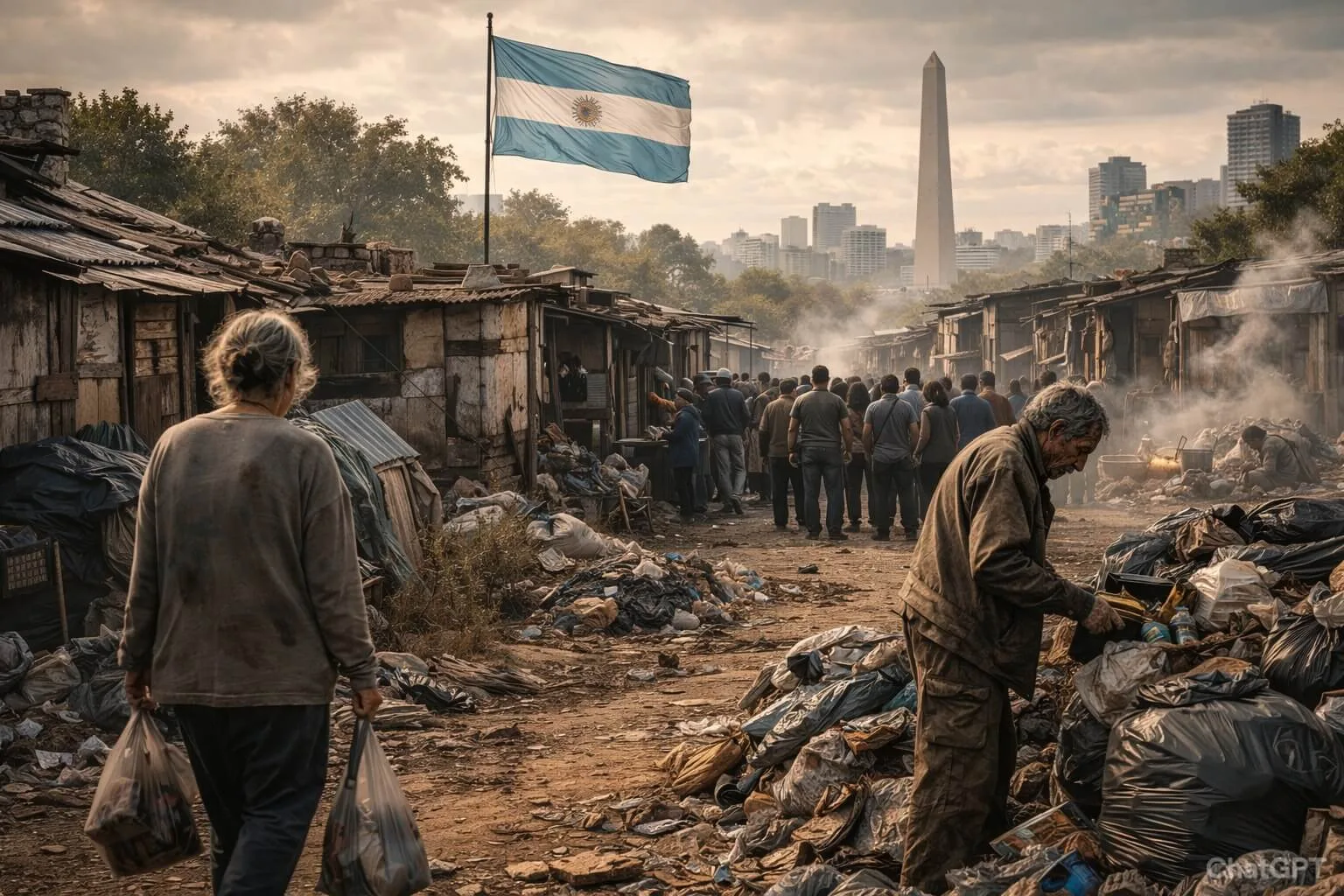
Poverty in Argentina remains at high levels after more than a decade marked by economic crises, adjustment programs, and changes in government, affecting access to basic rights such as food, healthcare, education, and housing.
Poverty in Argentina continues to be one of the country’s main social and economic challenges. According to recent official figures, 31.6% of the population cannot cover basic expenses such as food, transportation, healthcare, education, and clothing, while 6.9% live in extreme poverty, lacking sufficient income to afford a basic food basket.
During the government of Mauricio Macri (2015–2019), poverty levels ranged between 30% and 35%, in a context of external debt and fiscal adjustment. During that period, UNICEF warned about the impact of the crisis on children and adolescents, particularly regarding access to food and adequate living conditions.
With the arrival of the COVID-19 pandemic during the administration of Alberto Fernández, poverty rose to 41%, driven by the shutdown of economic activities and job losses. In 2021, Cáritas Argentina warned that demand at community kitchens reached “unprecedented” levels, highlighting a rapid deterioration in the right to food.
The scenario shifted again with the inauguration of Javier Milei and the implementation of an economic adjustment program that included currency devaluation and cuts to public spending.
Poverty in Argentina during Javier Milei’s administration
In the first months of his administration, poverty in Argentina climbed to 52.9%, although it later dropped to 31%, according to figures released by the national government.
“The adjustment was inevitable to avoid hyperinflation and lay the foundations for sustainable growth,” the president stated in public remarks.
However, the Center for Legal and Social Studies noted that the measures adopted had a “regressive impact on lower-income sectors,” affecting access to medications, food, and basic services.
A growing gap
Poverty in Argentina reflects not only material deprivation but also increasing inequality. In 2025, the richest 10% earned up to 19 times more than the poorest 10%.
For the Economic Commission for Latin America and the Caribbean (ECLAC), this gap represents one of the main obstacles to effectively guaranteeing economic and social rights in the region.
Poverty in Argentina’s major cities
The figures also reveal uneven realities depending on the region. In Rosario, one of the country’s most important agro-export hubs, nearly three out of ten residents live in poverty.
In Córdoba, the indicator reached a peak of 49.5% in 2024. Meanwhile, in Buenos Aires, 31.8% of the population faces poverty or extreme poverty, with significant territorial disparities in access to basic services.
Outlook on poverty in Argentina
The national government maintains that the recent reduction in poverty confirms the effectiveness of its economic direction. However, social organizations and academic sectors warn that improvements in some indicators do not immediately translate into a structural recovery in access to rights such as food, housing, healthcare, education, and decent work.
The evolution of poverty in Argentina will continue to be a key indicator for measuring economic stability and social cohesion in the coming years.
If you want to better understand how this reality is experienced in the country’s main cities and what lies behind these figures, we invite you to watch the full video: