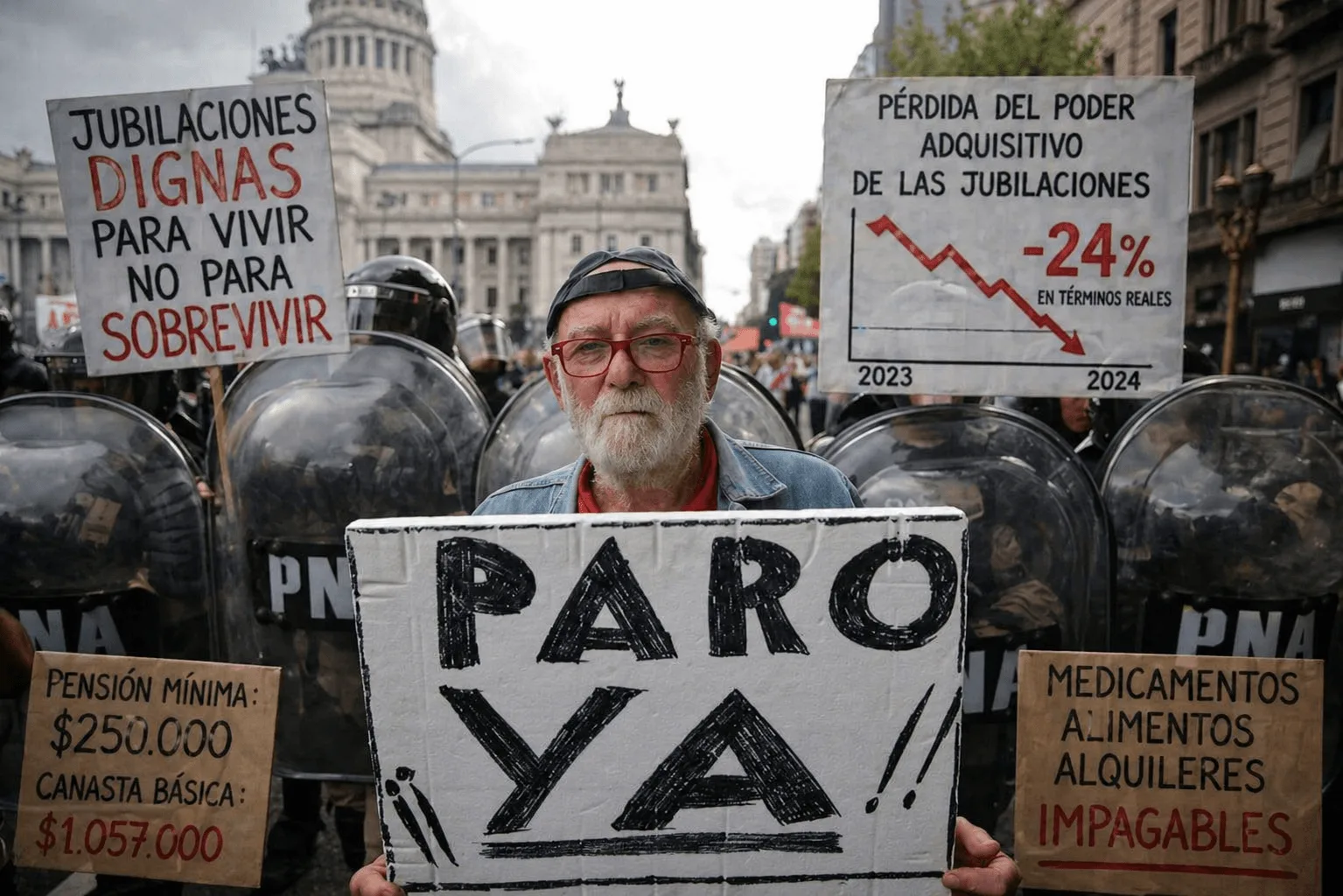
The situation of retirees in Argentina’s pension crisis reflects an increasingly critical scenario: insufficient minimum incomes, rising cost of living, and difficulties accessing food, medications, and decent housing.
Denied Rights in Latin America
“It’s not just me, it’s many of us.” The phrase, repeated by an elderly woman as she waits to collect a pension that barely reaches 250,000 Argentine pesos, reflects a reality that repeats itself every week outside Congress in Buenos Aires and in cities across the country. There, retirees and pensioners gather to demand sufficient income, access to medications, and basic living conditions.
Retirees in Argentina pension crisis: surviving on minimum income
Far from being an isolated protest, what is happening in Argentina reveals a structural crisis in the pension system that has deepened in recent years. Reports from the Ombudsman for the Elderly warn that older adults face a critical situation that combines difficulties in accessing food, medical treatment, and maintaining housing.
You may be interested in: Promises and results of Javier Milei’s government in Argentina: health, education, and the economy under debate
The figures are stark. At least 7 out of 10 retirees have had to reduce food consumption, while the price of essential medications continues to rise. Added to this is pressure from the housing market: an average rent can absorb up to 80% of a minimum pension, leaving thousands in a critical situation.
“The Argentine pension system has been losing its ability to guarantee dignified incomes for years,” explained economist Andrea Falcone. According to the expert, persistent inflation and changes in adjustment formulas have steadily eroded retirees’ purchasing power.
The impact of inflation on pensions
The impact has become even more evident over the past year. According to estimates by the Center for Argentine Political Economy (CEPA), minimum pensions have lost nearly 24% of their purchasing power in real terms. This deterioration coincides with fiscal adjustment measures implemented by President Javier Milei’s government, which have reduced public spending in several areas.
One of the most visible consequences is the return of older adults to the labor market. Data from the Ministry of Labor indicate that participation among people over 66 has increased by more than 10%, in many cases out of necessity rather than choice.
“We are seeing a reconfiguration of old age in Argentina,” warned sociologist Mariana Luzzi. “Retirement no longer guarantees a dignified life, but in many cases implies precariousness and economic dependence.”
Protests and reports of repression
At the same time, protests have gained strength. Every Wednesday, social organizations, unions, and even groups of football fans support demonstrations around Congress. However, these protests have also been marked by controversy.
The Center for Legal and Social Studies has documented episodes of repression, including the use of tear gas and cases of elderly people being injured. “It is concerning that legitimate demands for basic rights are met with institutional violence,” the organization stated in one of its reports.
Argentina maintains high levels of poverty after a decade of economic adjustments and crises
The current scenario is not new in the country’s history. During the 1990s, activist Norma Plá led protests against cuts to the pension system, with slogans that are once again relevant today. “I want to eat the same food government officials eat,” she said at the time, in a phrase that has become a symbol of retirees’ struggle.
The crisis also affects those receiving non-contributory pensions, especially people with disabilities. Organizations in the sector have reported delays in payments, outdated rates, and risks to the continuity of treatments. The National Disability Agency has been criticized by families and providers who warn about the system’s fragility.
Debt as a survival mechanism
In daily life, the situation translates into extreme decisions. “As soon as I get paid, I repay loans and then have to borrow again,” said one pensioner during a protest. Debt has become a common coping mechanism in the absence of sufficient income.
Data from the Central Bank of Argentina show an increase in the use of personal loans among older adults, a trend that reflects the inability to cover basic expenses with current pensions.
International organizations such as the Economic Commission for Latin America and the Caribbean have warned that population aging requires deep reforms to ensure sustainable pension systems. In Argentina, that debate remains unresolved.
Meanwhile, thousands of retirees continue to take to the streets demanding the same thing: minimum conditions to live. The crisis highlights not only economic deterioration but also a social debt that, far from being settled, continues to grow.
An unresolved social debt
Beyond changes in government, the problem appears to persist. For international organizations such as the Economic Commission for Latin America and the Caribbean (ECLAC), population aging in the region requires structural reforms to ensure sustainable and equitable pension systems.
In Argentina, however, the debate remains open. Meanwhile, thousands of retirees continue in the streets.
The question is no longer just how they survive, but how much longer a system can endure that, for many, has ceased to fulfill its essential function: guaranteeing a dignified old age.