Disinformation in Mexico has become an increasingly complex phenomenon that combines criminal violence, public fear, self-censorship, social media, and artificial intelligence. Experts warn that this combination is weakening access to reliable information and fueling the spread of rumors across different regions of the country.
Denied Rights in Latin America
Disinformation in Mexico is no longer limited to false messages or isolated viral posts. In several regions of the country, a much more complex ecosystem has emerged, where criminal violence, self-censorship, social media, public fear, and artificial intelligence converge. This phenomenon is raising growing concerns among researchers, human rights organizations, and digital communication experts.
You may also be interested in: Indigenous Gaps in Mexico: The Historic Debt of Inequality and Exclusion
Disinformation in Mexico: A Growing Challenge to Access Reliable Information
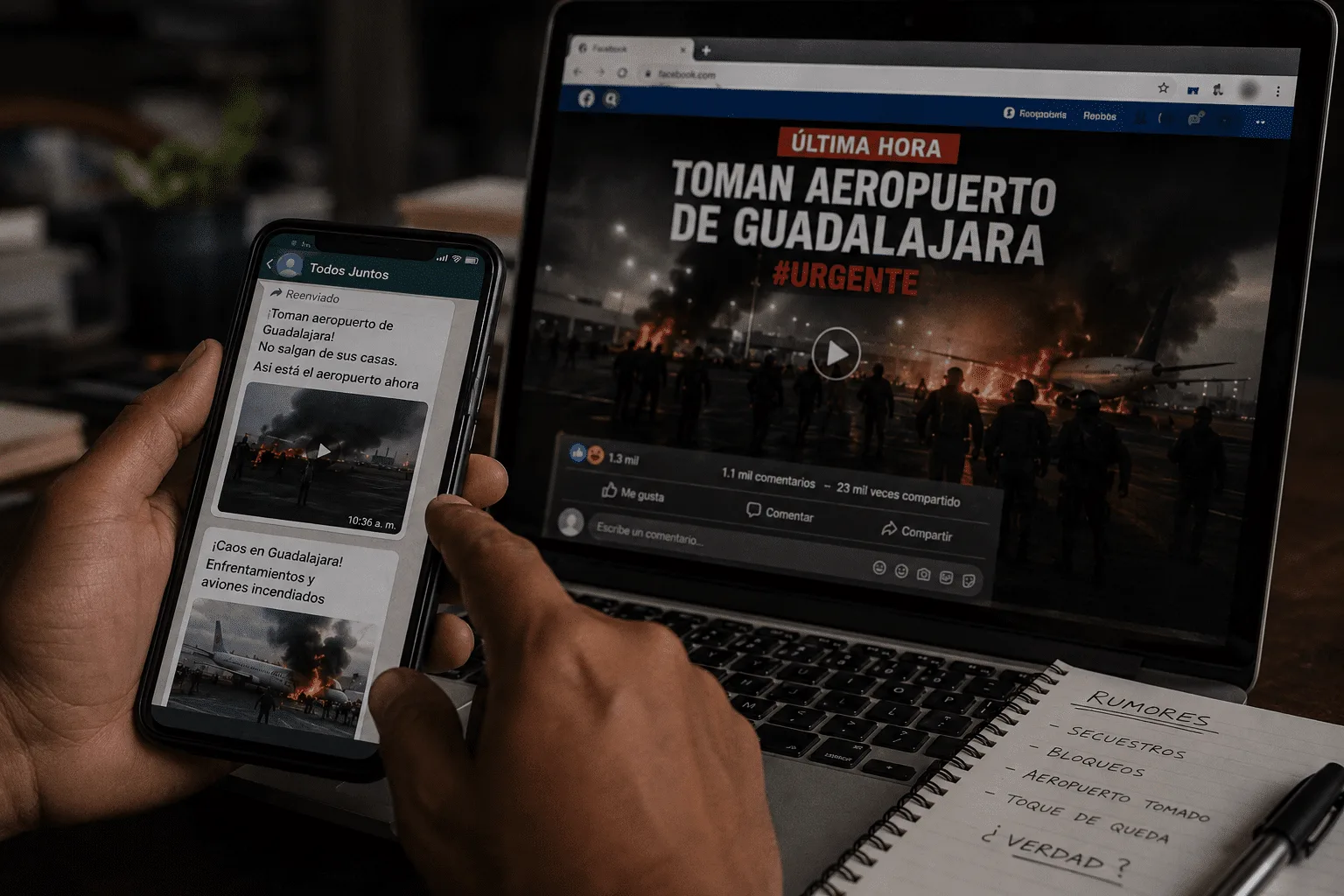
One of the most recent examples occurred in February 2026 following a federal operation in which Nemesio Oseguera Cervantes, known as “El Mencho,” was killed. Hours after the operation, videos and messages began circulating on social media claiming that members of the Jalisco New Generation Cartel (CJNG) had taken over Guadalajara International Airport in retaliation.
The images immediately sparked panic among thousands of users. Videos allegedly recorded inside the airport terminal appeared to show scenes of chaos, gunfire, and armed confrontations. Some national media outlets replicated the information amid the confusion. As the hours passed, authorities and fact-checkers determined that the content being shared was misleading. Although shootings and violent incidents did occur in areas near the airport, there was never an armed takeover of the terminal.
Part of the viral content included artificial intelligence-generated images depicting burning airplanes, non-existent armed attacks, and digitally fabricated scenes. Collective fear accelerated the spread of disinformation within minutes.
That same day, rumors also circulated regarding the alleged kidnapping of U.S. citizens in the state of Jalisco. While U.S. authorities issued security alerts and criminal road blockades were reported in several areas, no official reports ever confirmed the kidnapping of foreign tourists.
Violence and Lack of Information: A Dangerous Combination
For communication and digital behavior specialists, these episodes illustrate how local disinformation ecosystems currently operate in Mexico. The combination of criminal violence, the absence of immediate official information, and pressure on regional media creates ideal conditions for rumors, voice messages, and manipulated content to spread rapidly.
Researcher Rossana Reguillo has explained in various analyses that, in contexts of social fear, people tend to share information without verification due to the desire to stay informed or protected from potential risks. This dynamic becomes even stronger in regions affected by organized crime violence.
Related stories:
Mexico, One of the Most Dangerous Countries for Journalism: At Least 176 Journalists Killed Since 2000 Murdered Journalists in Mexico: The Territorial Pattern of Violence Against the Press
States such as Michoacán, Guerrero, Chiapas, and Jalisco are among the regions most vulnerable to this phenomenon. These areas combine threats against journalists, weak institutional presence, and the strong influence of criminal organizations that interfere with the flow of information.
The organization Article 19 has documented for years how violence against journalists in Mexico directly affects citizens’ right to access verified information. Recent reports show that many regional media outlets face constant threats, attacks, and economic pressures that often lead to self-censorship.
Self-Censorship and the Information Vacuum
In various parts of Mexico, journalists and local communicators have stopped covering topics related to drug trafficking, corruption, and violence out of fear of retaliation. This information vacuum is often filled by anonymous WhatsApp messages, unidentified social media accounts, and videos taken out of context.
Freedom of expression organizations have warned that “the absence of reliable information strengthens rumors,” a situation that has become increasingly evident in states where reporting has become a high-risk activity.
The problem is also growing with the advancement of artificial intelligence tools capable of generating increasingly realistic images, audio recordings, and videos. In rural Mexican communities, false videos recently went viral claiming to show women transforming into animals or “witches” in small towns. Several digital platforms and regional media outlets shared the content without verifying its authenticity.
Digital communication experts argue that modern disinformation no longer depends solely on traditional fake news. The phenomenon is now fueled by manipulated visual content designed to appeal directly to fear, sensationalism, and immediate emotions in order to achieve greater virality.
Continue Reading:
Narco-Censorship in Mexico: Violence Against Journalists and Information Control Deepen the Democratic Crisis Hate speech and gender-based violence in Mexico raise alarms over setbacks in rights.
Social Media and Public Trust
Research conducted by the National Autonomous University of Mexico (UNAM) in 2021 revealed the scale of the problem. Nearly 50 percent of Mexicans reported trusting information received through social media platforms, particularly WhatsApp and Facebook.
However, the statistic that concerns researchers the most is another one: 94 percent of respondents stated that they felt capable of distinguishing between true and false information. Analysts believe this perception creates a particularly vulnerable environment because many individuals assume they are protected from digital manipulation when, in reality, they may become unintentional amplifiers of disinformation.
A Challenge for Democracy and Freedom of Expression
During the COVID-19 pandemic, the phenomenon became fully visible. False messages promoting miracle cures, conspiracy theories, and misleading content related to vaccines and public health measures spread widely. The World Health Organization warned that the so-called “infodemic” could cause damage even greater than the health emergency itself because of the speed at which false information about public health was spreading.
Experts in freedom of expression and governance argue that the current problem goes far beyond fake news. The greatest concern arises when disinformation intersects with violence, fear, and forced silence in territories where providing information can cost lives.
Various specialists agree that addressing this phenomenon requires strengthening local journalism, protecting communicators, and ensuring safe conditions so that communities can access reliable and verified information.
Learn in the following video how this phenomenon operates and why it represents a major challenge to access to truth.