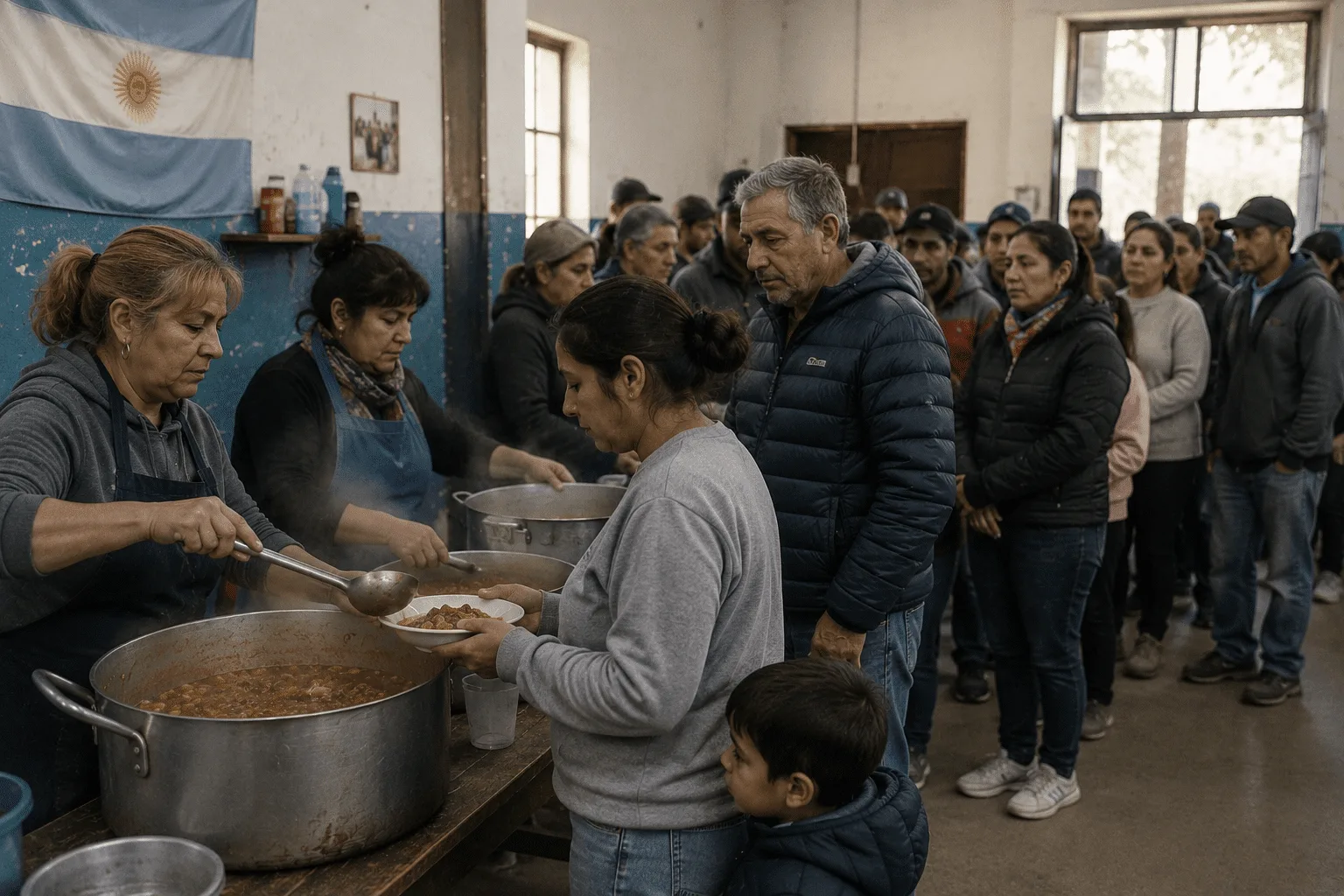
Community kitchens in Argentina have become a vital lifeline for thousands of families struggling to access adequate food. Social organizations warn that rising poverty, budget cuts, and food shortages are putting the continuity of these assistance programs at risk.
Denied Rights in Latin America
The crisis facing community kitchens in Argentina has become one of the clearest reflections of the country’s social and economic deterioration. As poverty increases and thousands of families struggle to secure daily meals, social organizations and community leaders are warning about a scenario marked by food shortages, budget reductions, and the closure of food assistance centers.
You may also be interested in: Retirees in Argentina: Surviving on Minimum Pensions Amid an Unrelenting Crisis
The figures reveal the scale of the emergency. According to data released by Argentine social organizations, 64.8% of the country’s children currently depend on some form of free food assistance, highlighting the growing number of households that rely daily on soup kitchens, snack centers, and community meal programs.
Community Kitchens in Argentina Face Growing Demand as Poverty Rises
Reports published by Argentine media outlets also indicate that 6.5% of households currently attend community kitchens in order to eat. The phenomenon is now affecting sectors of society that previously did not require state or community assistance but are now facing the consequences of inflation and declining purchasing power.
“For those families, the neighborhood kitchen is the difference between eating and not eating,” says a woman in one of the videos shared from Buenos Aires, describing how more people arrive each week while the amount of food available for distribution continues to decrease.
The situation is unfolding amid the economic adjustment policies promoted by the administration of President Javier Milei and ongoing controversies surrounding the management of Sandra Pettovello, Minister of Human Capital.
Several organizations have reported that the government announced assistance for nearly 5,000 community kitchens, but support ultimately reached only 1,552 facilities. At the same time, social groups and policy experts warned that funding allocated to food assistance programs fell by nearly 65% in real terms during 2024, directly affecting food distribution initiatives and nutritional aid programs.
The Controversy Over Stored Food Supplies
The controversy intensified when Argentina’s judiciary ordered the distribution of food stored in government warehouses. In May 2024, Federal Judge Sebastián Casanello instructed the Ministry of Human Capital to present an urgent plan for distributing more than five million kilograms of food that had remained in state storage facilities while community kitchens reported shortages and increasing demand.
Continue Reading:
Lower middle class in Argentina: living day to day in a country where working no longer guarantees stability Argentina maintains high levels of poverty after a decade of economic adjustments and crises
The case attracted international attention. News agency Reuters reported that the controversy surrounding the stored food supplies evolved into a political crisis for the Argentine government due to the contradiction between rising hunger levels and the retention of food intended for vulnerable populations.
Community organizations intensified their criticism in the following weeks. The collective Cocineras contra el Hambre (Cooks Against Hunger), made up of workers and organizers of community meal programs, staged protests outside the Ministry of Human Capital demanding the immediate delivery of food supplies.
In a statement released by social organizations, representatives of the group declared: “For every community kitchen that closes, entire families lose access to a meal. Children are left without snacks and food assistance.”
The School Support and Complementary Education Network also reported that at least 13 community kitchens in the Greater Buenos Aires Metropolitan Area closed due to the lack of national funding, affecting more than 3,000 people who depended daily on this assistance.
Hunger as a Human Rights Issue
For international organizations such as UNICEF, the problem extends beyond the economic emergency and represents a situation of vulnerability for millions of children and adolescents. Various humanitarian agencies have warned about the effects of food insecurity in contexts of extreme poverty and the long-term consequences of inadequate nutrition during childhood.
The right to food is recognized in both the Universal Declaration of Human Rights and the International Covenant on Economic, Social and Cultural Rights, international agreements signed by Argentina.
Amid the public debate, social organizations argue that the food crisis is not merely an economic issue but also a violation of fundamental rights, particularly affecting children and older adults.
You may also be interested in: Promises and results of Javier Milei’s government in Argentina: health, education, and the economy under debate
Journalist and writer Martín Caparrós, author of the book Hunger, has argued in various interviews that hunger is not caused by a lack of food but by political and economic decisions that exclude millions of people. “Hunger is not a natural tragedy,” the author has stated while analyzing social inequalities in Latin America.
While political and legal debates over food assistance continue, local communities themselves are keeping community kitchens operating in working-class neighborhoods. A recent Reuters report showed how the childhood home of Diego Maradona in Villa Fiorito was transformed into a community kitchen serving hundreds of residents who arrive each week seeking a hot meal.
Volunteers and coordinators of these community spaces continue to insist that food is a basic right that must be guaranteed by the state, while thousands of families remain dependent on community kitchens every day in order to eat.
In the following video, learn how these community initiatives are responding to growing demand, allegations of insufficient resources, and the impact of this situation on the most vulnerable populations.