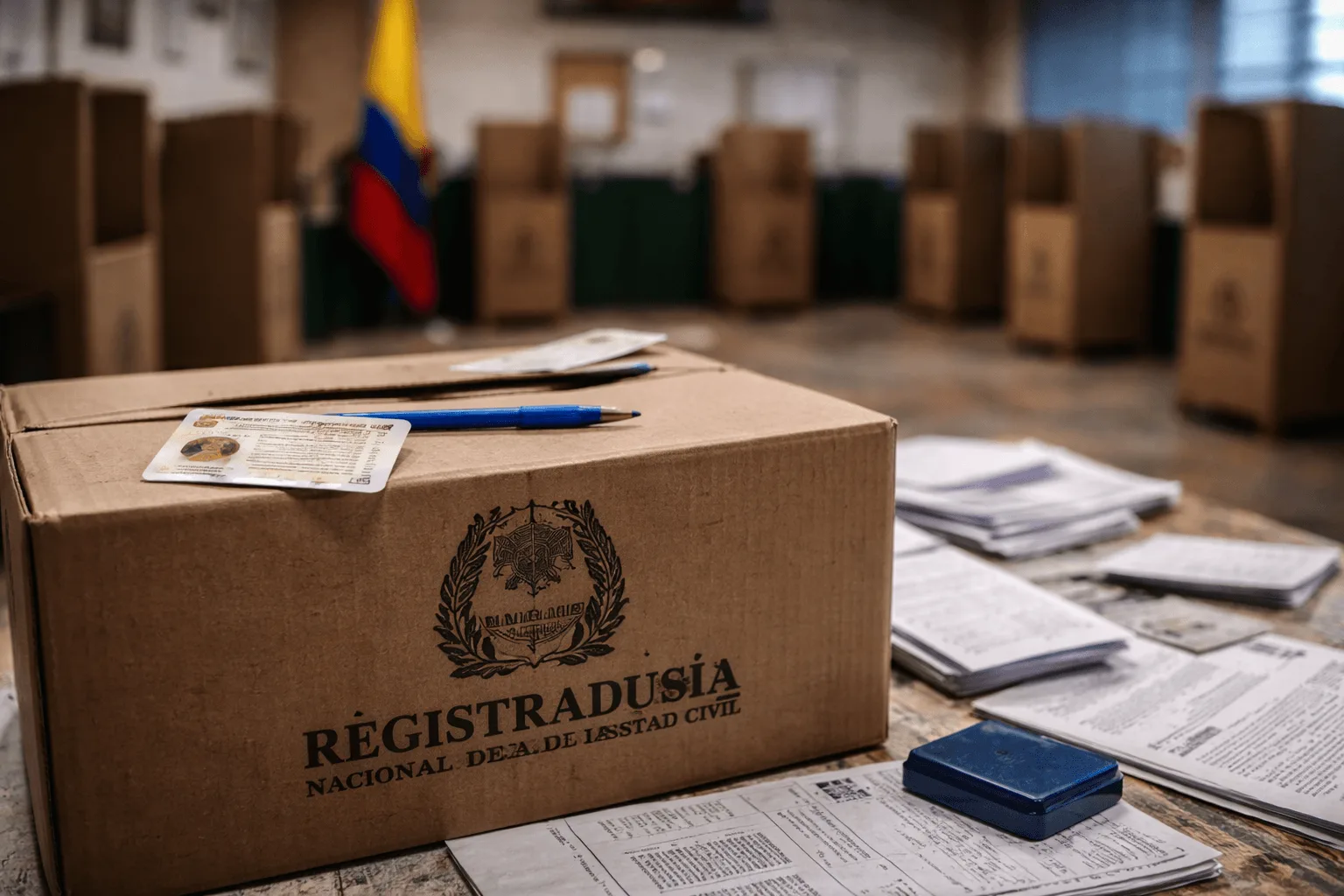
Voter abstention in Colombia has returned to the center of political debate following the most recent legislative elections, in which nearly half of the electoral roll chose not to go to the polls.
Abstention in Colombia: a historical phenomenon in Colombian elections
Abstention has once again taken center stage in Colombia’s political debate. In every election cycle, the same pattern repeats: millions of eligible voters decide not to cast their ballots, a trend that directly influences how political power is shaped in the country.
In the most recent legislative elections, close to half of the electorate did not participate in choosing members of the Congress of the Republic, the body responsible for approving the national budget, setting taxes, and processing structural reforms in labor, pension, and healthcare issues.
You may be interested in: The start of Colombia’s electoral campaign sparks debate over political attacks versus proposals
This figure has reignited discussion about the possibility of introducing mandatory voting in Colombia as a mechanism to increase citizen participation and strengthen the legitimacy of public decisions.
The National Civil Registry has warned that abstention has historically been one of the main challenges of Colombia’s electoral system. According to its reports, despite logistical and educational efforts in every election process, voter turnout in legislative elections has struggled to significantly exceed 50%.
A historical trend in Colombian elections
This phenomenon is not new. Since the 1991 Constitution, Colombia has adopted a voluntary voting model based on the premise that suffrage is a citizen’s right, not an obligation. However, in academic and political circles, the debate has resurfaced over whether this model is still sufficient to guarantee a fully representative democracy.
Political scientist Yann Basset, a professor at Universidad del Rosario, argues that abstention in Colombia is driven by multiple factors, ranging from institutional distrust to logistical challenges in certain regions of the country.
“It is not a homogeneous phenomenon; it responds to both structural and cultural factors,” the academic has stated in various public discussions.
The Electoral Observation Mission (MOE), an organization dedicated to monitoring electoral processes in Colombia, has also warned that low participation levels may affect the perceived legitimacy of political decisions.
In several of its reports, the organization has emphasized that a strong democracy requires not only guarantees for exercising the right to vote, but also conditions that encourage citizens to actively participate in electoral processes.
The impact of low turnout on Congress
The effects of abstention are directly reflected in how seats in Congress are allocated. When voter turnout is low, the absolute number of votes required to secure representation also decreases.
In practice, this means that an active minority of the electorate can end up determining the composition of the legislative branch, while a significant portion of citizens remains outside the process.
Constitutional expert Rodrigo Uprimny has pointed out in various debates that democratic legitimacy depends not only on the legality of elections but also on the level of citizen participation.
“Democracy is strengthened when it expands participation, not when it is reduced to an organized minority,” the jurist has stated in public discussions on the issue.
Continue reading:
How influence networks have led to the loss of congressional seats and scandals in Colombia How political machines operate in Colombia: abstentionism that turns voting into power Political violence and hate speech intensify on social media ahead of elections in Colombia
Experiences with mandatory voting in Latin America
In this context, some analysts have begun to suggest that Colombia could adopt a mandatory voting system similar to those in several Latin American countries.
Brazil and Argentina are among the most frequently cited examples. In both countries, voting is compulsory, and unjustified abstention may lead to administrative or financial penalties for those who fail to participate.
In Brazil, for example, non-voters may face symbolic fines and difficulties completing certain procedures with the state. In Argentina, legislation also предусматривает sanctions, although their enforcement has varied over time.
According to electoral statistics from these countries, turnout levels are generally higher than those recorded in Colombia, leading some experts to suggest that mandatory voting could increase participation.
The role of electoral institutions
However, other scholars warn that forced participation does not necessarily translate into higher-quality democracy, as mandatory voting does not by itself guarantee a more informed citizenry or a more transparent political system.
The National Electoral Council (CNE) has stated that any attempt to introduce mandatory voting in Colombia would require a constitutional reform and broad political consensus in Congress.
Additionally, such a debate would involve defining key aspects such as the type of sanctions for non-voters and the balance between civic duty and individual freedom.
For the Electoral Observation Mission, beyond the discussion of compulsory voting, the main challenge remains rebuilding public trust in the political system.
The organization has emphasized that combating corruption, strengthening transparency in campaign financing, and ensuring security conditions across regions could have a deeper impact on voter participation than any coercive measure.
Citizen participation and democratic legitimacy
At the same time, surveys conducted by academic institutions and polling firms have shown that part of the population would be willing to consider mandatory voting if it helps reduce the influence of political machines and improve institutional representation.
Meanwhile, the Congress of the Republic continues to make decisions that directly affect the daily lives of millions of Colombians—from approving structural reforms to defining the tax system and exercising political oversight of the national government.
However, in every legislative election, millions of eligible voters choose not to participate. In this context, the debate over whether Colombia should maintain voluntary voting or move toward a mandatory system remains open.
Watch the full analysis in the video below: