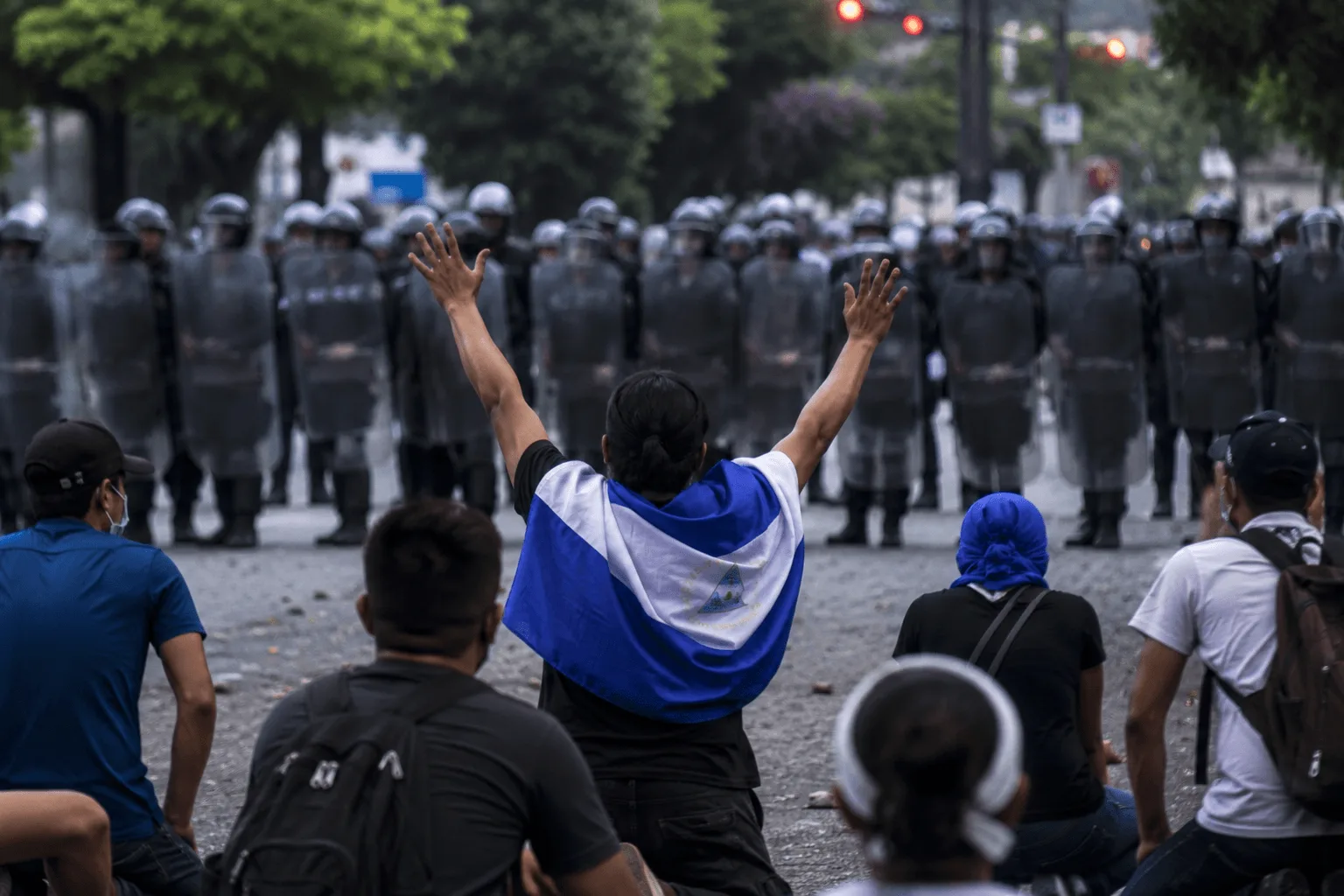
Human rights in Nicaragua remain at the center of international debate due to ongoing reports of repression, restrictions on fundamental freedoms, and the deterioration of civic space since the 2018 social protests. International organizations and human rights defenders warn that the situation continues to undermine rights such as freedom of expression, peaceful protest, political participation, and religious freedom.
Denied Rights in Latin America
Human Rights in Nicaragua: A Crisis That Continues to Draw International Attention
Since the 2018 social protests, Nicaragua has experienced one of the most heavily criticized periods in its recent history regarding human rights. What began as a wave of demonstrations against the government of Daniel Ortega evolved, according to international organizations, into a crisis characterized by state repression, restrictions on fundamental freedoms, and persecution of critical voices.
Read: Nicaragua bans Holy Week processions and deepens restrictions on religious freedom
More than seven years after those protests, the debate surrounding the so-called "denied rights" in Nicaragua continues to grow both inside and outside the country.
In an exclusive interview with TUBARCO, Luis Quiñónez, former security adviser to former U.S. President Donald Trump, stated that international investigations involving Daniel Ortega focus not only on alleged links to drug trafficking or corruption but also on possible systematic human rights violations committed during his administration.
"In Nicaragua, people cannot protest, religious freedom is denied, and even gathering as a society is denied," Quiñónez said during the interview. He also argued that the country's internal situation could eventually lead to international investigations into alleged crimes against humanity.
These allegations are consistent with reports issued by international organizations since the 2018 protests. The Inter-American Commission on Human Rights (IACHR) documented more than 300 deaths during the repression of the demonstrations, over 2,000 injuries, and dozens of reports involving enforced disappearances, arbitrary detentions, and political persecution.
The Office of the United Nations High Commissioner for Human Rights has also stated in several reports that Nicaragua continues to face severe restrictions on fundamental freedoms, including freedom of expression, association, and political participation.
Press Freedom and Civic Space Under Constant Scrutiny
One of the issues generating the greatest concern in recent years has been the progressive closure of civic space and independent media outlets.
Reporters Without Borders has reported that Nicaragua has become one of the most restrictive environments for journalism in Latin America. Independent journalists, digital media outlets, and critical communicators have reported newsroom closures, confiscations, forced exile, and judicial proceedings targeting opposition voices.
Journalist and author Carlos Fernando Chamorro, director of the independent news outlet Confidencial and one of Nicaragua's best-known independent journalists, has repeatedly warned that the country is experiencing a "systematic dismantling of public freedoms."
Chamorro was forced to leave Nicaragua after denouncing state persecution of journalists and independent media.
The crisis has also affected civil society organizations, universities, and religious groups.
According to reports from organizations defending religious freedom, at least 309 alleged violations of this right were documented during 2025 alone, including restrictions on Catholic celebrations, expulsions of religious leaders, police surveillance, and the closure of organizations linked to churches.
You may be interested in: International organizations warn of a total dismantling of freedoms in Nicaragua under the Ortega-Murillo regime.
Christian Solidarity Worldwide and other international monitoring organizations have warned of increasing restrictions targeting religious leaders and church activities.
Religious Freedom and Citizen Participation Remain at the Center of the Debate
The case of the Catholic Church has been especially prominent. In recent years, priests, bishops, and religious leaders have reported surveillance, detentions, and restrictions on pastoral activities and public religious processions.
For many analysts, Nicaragua's democratic decline cannot be understood solely from a political perspective. It also involves growing restrictions on fundamental rights such as freedom of expression, religious freedom, and the right to peaceful protest.
Human Rights Watch has argued in several reports that the Nicaraguan government maintains a strategy of repression aimed at neutralizing any form of political or social dissent.
"There are people who are completely oppressed," Luis Quiñónez said when referring to the situation currently faced by many Nicaraguan citizens.
The situation has also triggered significant migration. International organizations estimate that hundreds of thousands of Nicaraguans have left the country in recent years because of the ongoing political, economic, and social crisis.
Meanwhile, the government of Daniel Ortega and Rosario Murillo rejects the international allegations, arguing that the measures adopted are a response to attempts at political destabilization promoted by opposition groups and foreign actors.
The Debate Over Fundamental Rights Remains Open
For human rights organizations, the discussion goes beyond traditional political disagreements.
The central issue concerns fundamental rights that, according to international organizations and opposition groups, have been progressively restricted in Nicaragua: the right to protest, report freely, assemble peacefully, practice religion, and participate in public life without fear.
When fear begins to limit civic participation, freedom of expression, or religious practice, the consequences extend beyond politics. They become a broader discussion about fundamental rights and the extent to which democratic freedoms continue to exist in Nicaragua.