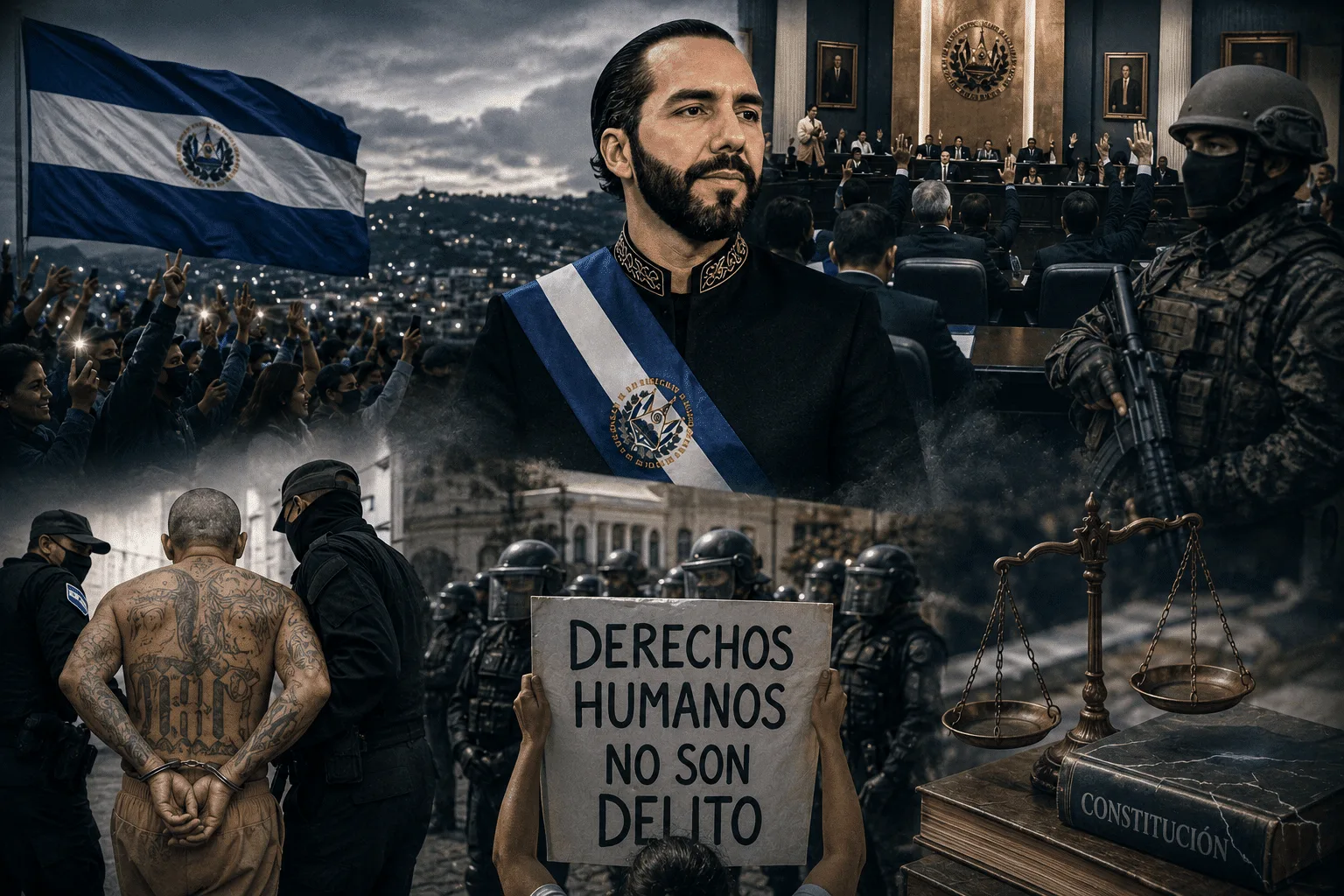
Denied rights in El Salvador have become one of the most intense debates in Latin America. While Nayib Bukele’s government highlights the reduction in homicides and strong public support for its security strategy, international organizations warn about democratic restrictions and the concentration of power.
Denied Rights in Latin America.
In just a few years, El Salvador went from being a country devastated by gang violence to becoming one of the most closely watched and debated political cases in Latin America. While President Nayib Bukele’s government points to a historic reduction in homicides and high approval ratings, international organizations warn about a progressive democratic decline and restrictions on fundamental rights.
Bukele’s rise to power in 2019 marked the end of the historic two-party dominance of ARENA and the FMLN. According to El Salvador’s Supreme Electoral Tribunal, the then-candidate won in the first round with 53% of the vote, consolidating an anti-establishment message that resonated with millions of citizens tired of corruption, insecurity, and criminal violence.
You may also be interested in: Can journalists report freely in El Salvador? Allegations of espionage, journalists in exile, and the debate dividing the country
His victory was presented as a break from the old Salvadoran political class. However, analysts argue that this popular discourse quickly evolved into a model of unprecedented concentration of power in the country.
Military Presence in Congress Triggered International Alarm
One of the first events that sparked international concern occurred on February 9, 2020. That day, Nayib Bukele entered the Legislative Assembly chamber accompanied by armed soldiers to pressure lawmakers into approving funds for his security plan.
The images spread around the world and prompted strong criticism from international organizations.
Human Rights Watch described the episode as an alarming sign of institutional deterioration. José Miguel Vivanco stated at the time that “using the Armed Forces to pressure the legislative branch represents a serious democratic threat.”
The Ruling Party Consolidated Institutional Control
In 2021, another key turning point arrived in El Salvador’s political transformation. The ruling party, Nuevas Ideas, won 56 of the 84 seats in the Legislative Assembly, consolidating almost absolute control of Congress.
That majority allowed rapid institutional reforms that altered the balance of powers. That same year, the Assembly dominated by the ruling party dismissed Supreme Court magistrates and the attorney general.
The Inter-American Commission on Human Rights questioned the decision and warned about risks to judicial independence. “The separation of powers is essential to protect citizens’ rights,” the organization stated in one of its reports on El Salvador.
Amnesty International also warned about a weakening of democratic checks and balances following the dismissals.
The State of Exception Continues to Spark Controversy
For researchers and regional analysts, El Salvador began showing patterns associated with authoritarian concentrations of power. Manuel Meléndez-Sánchez has warned that “the weakening of independent institutions is often one of the first signs” in these kinds of political transformations.
The government’s most controversial measure came in March 2022, following a surge in homicides attributed to gangs. The Executive branch declared a state of exception that suspended constitutional guarantees and remains in force more than three years later.
According to official figures, more than 80,000 people have been arrested, and the country recorded a historic reduction in homicides. The government argues that the strategy transformed El Salvador into one of the safest countries in Latin America.
But human rights organizations describe a different reality.
Cristosal has documented thousands of complaints involving alleged arbitrary detentions, due process violations, and deaths in state custody.
Ruth López, a representative of the organization, has warned about “serious violations of fundamental rights” during the state of exception.
Amnesty International also warned about permanent restrictions on civil liberties and constitutional guarantees under the argument of security.
The Salvadoran government rejects these accusations and argues that international organizations ignored for years the suffering caused by gangs and criminal violence.
Bukele Reelection Intensified Political Debate
In 2024, Nayib Bukele was reelected in a process that sparked intense legal and constitutional debate. His candidacy was approved by magistrates appointed after the institutional restructuring promoted by the ruling party, despite questions regarding the legality of immediate reelection.
For critics and academic sectors, this represented the consolidation of a model of absolute control over power. For his supporters, it meant the democratic ratification of a leader overwhelmingly backed at the ballot box.
Today, El Salvador divides opinions both within and outside the region. While millions of citizens celebrate the reduction in violence and the recovery of safety in the streets, international concerns continue to grow regarding the state of democracy, institutional independence, and respect for fundamental rights.
The Salvadoran case has therefore become one of the most complex political debates in Latin America: how much freedom and constitutional guarantees a society is willing to sacrifice in exchange for security and stability.