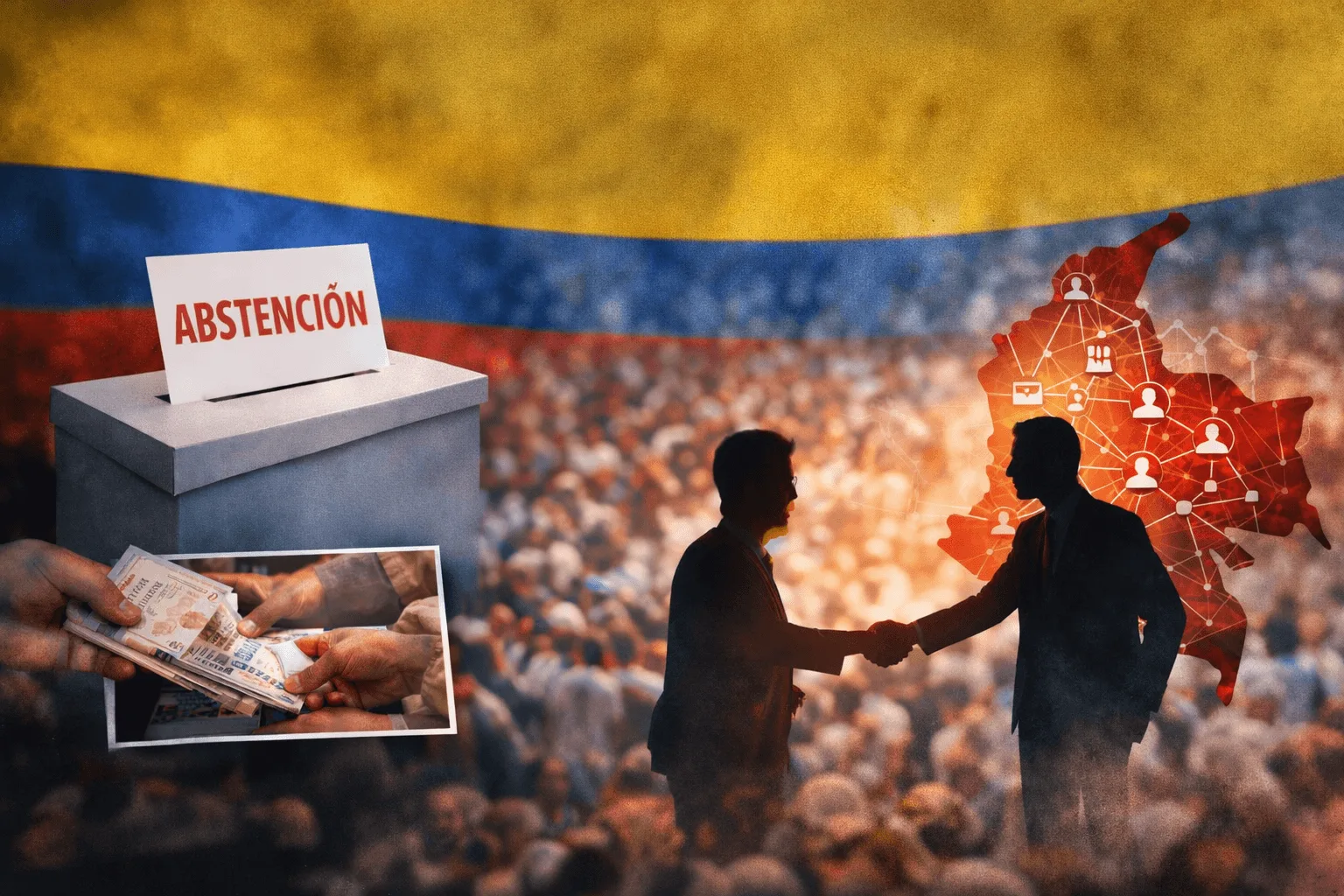
Electoral abstention in Colombia exceeds 50% in legislative elections and has become a key factor that strengthens political machines, reduces democratic competition, and shapes representation in Congress.
Denied Rights in Latin America.
The high level of electoral abstention in Colombia has become one of the main factors favoring the persistence and strengthening of political machines, as warned by electoral observation bodies and political science experts.
Abstention above 50% in legislative elections
According to historical records, abstention in legislative elections has repeatedly surpassed 50%, meaning that more than half of eligible voters do not participate in choosing Congress. Far from being marginal, this behavior directly impacts how political power is distributed.
You may be interested in: Political violence and hate speech intensify on social media ahead of Colombia’s elections
The Electoral Observation Mission (MOE) has stated that low participation “reduces electoral competitiveness and amplifies the weight of clientelist structures over independent voting.” In practice, when fewer people vote, the number of votes needed to win a seat decreases, making it easier for organized and disciplined structures to impose their results.
As explained by political scientist Yann Basset, professor at Universidad del Rosario, this operational model is based on the fragmentation of the electorate. “Citizens are divided into controllable micro-structures, where loyalty weighs more than political conviction,” the academic noted while analyzing campaigns driven by political machinery.
Local leadership and vote quotas
These structures do not prioritize mass persuasion or public debate. Their strategy focuses on identifying local leaders in neighborhoods, rural areas, or residential complexes, who are assigned specific vote targets that must be met. According to experts, these quotas function more as political commitments than voluntary support.
Electoral logistics include detailed lists with names, ID numbers, polling stations, and voting tables, allowing for close monitoring of electoral behavior before and during election day. Colombia’s National Civil Registry has warned that these practices are part of what is known as “structural clientelism,” a distortion of the democratic process operating at the margins of legality.
The exchange of favors is another key component. Incentives to secure votes are not always cash, but may include contracts, temporary jobs, promises of continued employment, or easier access to government procedures. Transparency for Colombia has warned that such practices turn voting into a transaction. “When the vote is conditioned by basic needs or veiled threats, it ceases to be a democratic expression,” the organization has stated.
On election day, political machines activate a logistical operation that includes transporting voters, constant phone calls, attendance verification, and social pressure on those who have not yet voted. After polls close, results are reviewed by polling station to measure compliance with established targets.
Abstaining does not punish the system—it strengthens it
For the MOE, abstention does not weaken these structures; it strengthens them. The organization has indicated that mass abstention “does not punish the political system, but rather strengthens those who already have mechanisms of territorial control,” by reducing the weight of independent voting and increasing the influence of organized networks.
Academics from the Institute of Political Studies at the National University have warned that these practices consolidate “vertical chains of loyalty,” in which elected members of Congress are more accountable to those who secure votes than to the broader electorate.
The phenomenon has also been identified as a violation of fundamental rights, including the right to vote freely, effective political participation, and equality of the vote, as it consolidates political representation conditioned by favors and prior commitments.
In this context, abstention remains a structural element of Colombia’s electoral system, with direct effects on the composition of Congress and the functioning of representative democracy.