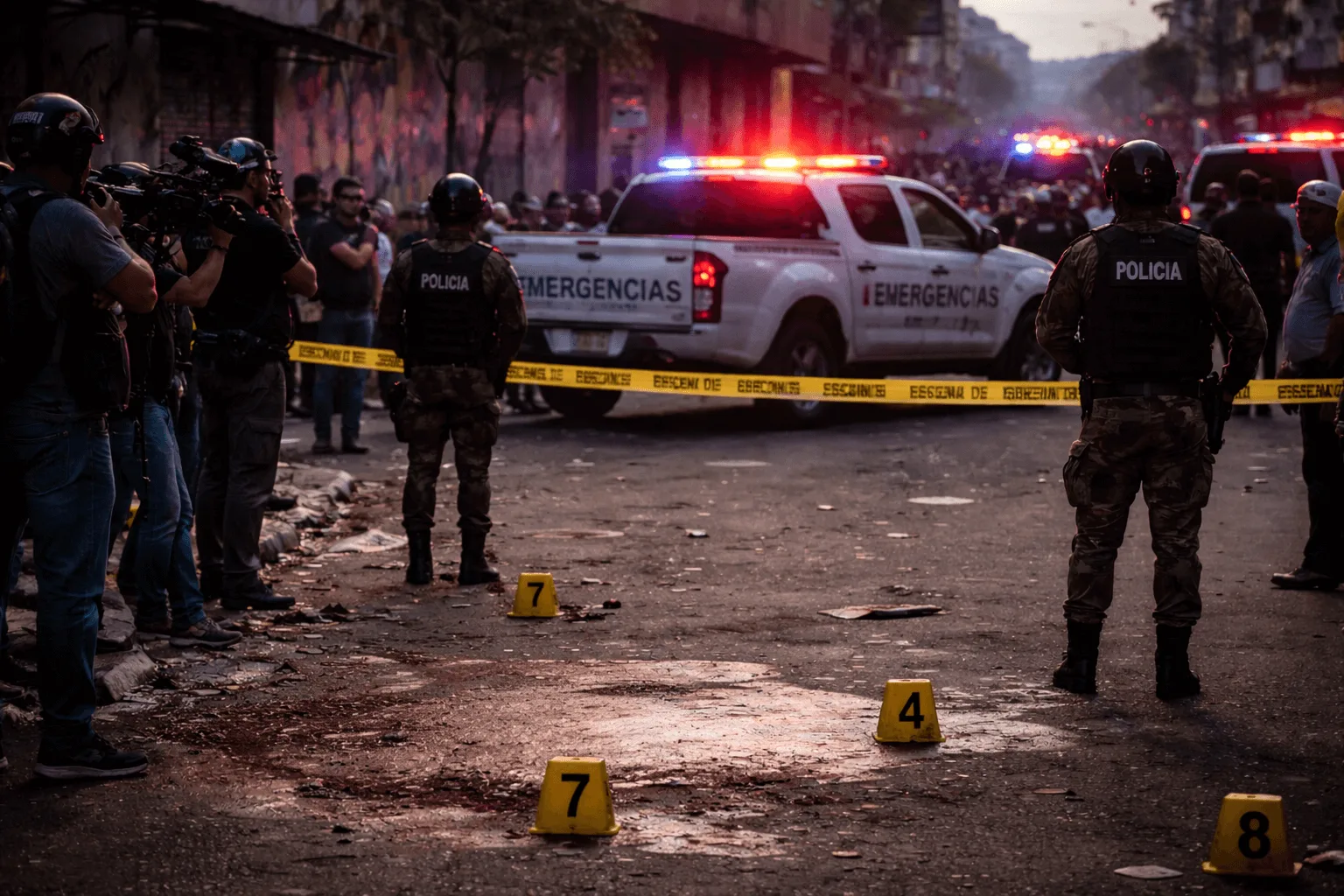
Political violence and organized crime in Ecuador have become a determining factor in the country’s ongoing security crisis, affecting electoral processes, local authorities, and the practice of journalism across different territories.
Denied Rights in Latin America
Ecuador is going through one of the most violent periods in its recent history amid the expansion of organized crime, which now impacts not only public safety but also electoral competition, local governance, and journalism.
Figures from the Ministry of the Interior indicate that 2025 ended with more than 9,100 homicides—the highest annual figure ever recorded in the country. The average exceeds 25 killings per day. Although most of these cases are linked to disputes between criminal groups, several incidents have directly targeted individuals involved in political and public life.
You may be interested in: Ecuadorian deportees from the United States: more than 9,000 face reintegration challenges in Ecuador
Political violence and organized crime in Ecuador following the assassination of candidates
The assassination of presidential candidate Fernando Villavicencio in August 2023 marked a turning point. Weeks earlier, Manta’s mayor at the time, Agustín Intriago, had also been killed. Both crimes occurred during active political engagement and raised alarms about the vulnerability of those participating in elections or holding public office.
In various provinces, candidates for city councils, mayoral offices, and parish boards have reported threats during recent campaigns. Some reduced public events and reinforced private security measures following risk warnings, according to local reports.
President Daniel Noboa has stated that the country is facing an “internal armed conflict” against criminal organizations seeking to control territories and challenge the State. The government has defended states of emergency, joint operations with the Armed Forces, and legal reforms aimed at increasing penalties as part of its strategy.
Under international scrutiny
However, international organizations have warned that the impact goes beyond armed confrontation. The Inter-American Commission on Human Rights has emphasized in public statements that the State must guarantee the right to life and political participation free from coercion. It has noted that violence against candidates and authorities can undermine the integrity of democratic processes.
Similarly, Human Rights Watch has warned that the growth of organized crime poses a structural risk to fundamental rights if investigative and judicial capacities are not strengthened.
Violence has also reached journalism. The precedent of the kidnapping and murder of the El Comercio newspaper team in 2018 showed that covering organized crime can have deadly consequences in high-conflict areas.
You may be interested in: This is how tension is unfolding at the Colombia–Ecuador border: tariffs and energy suspension strain diplomatic relations
In recent years, the organization Fundamedios has documented threats, attacks, and harassment against journalists investigating corruption or criminal networks. The group has warned that the climate of intimidation may lead to self-censorship, especially in territories where armed groups have a strong presence.
A threat to democratic stability
Security experts warn that when violence conditions campaigns, limits political activities, or inhibits journalistic work, it does not only affect individuals—it also undermines rights protected by the Constitution and international treaties, including the rights to life, to vote and be elected, to participate in public affairs, and to freedom of expression.
The Attorney General’s Office continues to investigate several crimes involving political actors and has reported arrests in some cases. However, analysts note that a deeper debate persists: if engaging in politics entails extraordinary risks to life, electoral competition may be distorted and institutional trust weakened.
The government maintains that its actions have delivered significant blows to criminal structures. Human rights organizations, meanwhile, insist that the response must combine security measures with institutional strengthening and efforts to reduce impunity.
The accumulation of assassinations, threats, and attacks against candidates, authorities, and journalists has placed the direct relationship between security and democracy at the center of national debate. In a context where violence begins to influence who can campaign or what can be investigated, the issue goes beyond crime and enters the realm of democratic stability.
This report reconstructs how organized crime shifted from disputing territories to influencing Ecuadorian politics—and why campaigning today can become a real risk.