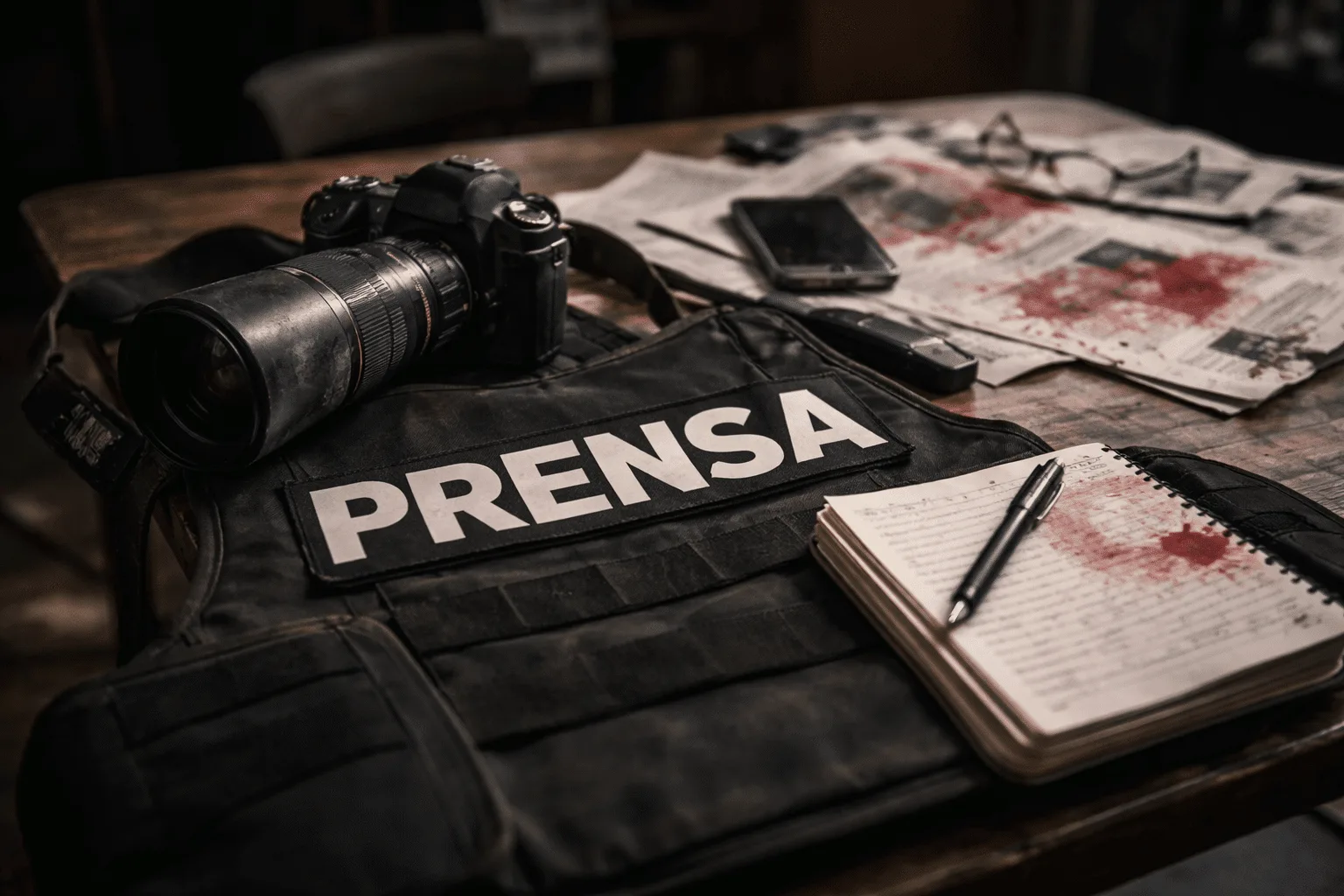
Journalists killed in Mexico reflect a territorial pattern of violence that has been repeated for decades, keeping the country among the most dangerous in the world for practicing journalism.
Denied Rights in Latin America
Violence against journalists in Mexico continues to show a recurring pattern over the years, maintaining the country among the most dangerous places in the world for the profession. Although attacks on the press occur across different regions, various investigations have identified a clear geography of violence: it is concentrated in specific states and driven by dynamics where organized crime, political corruption, and institutional weakness converge.
In Latin America, practicing journalism can become a high-risk activity. In Mexico’s case, the danger is not a perception but a reality documented over decades. International and local organizations agree that the country remains one of the deadliest for journalists, raising constant concerns about the protection of press freedom.
You may be interested in: Mexico, one of the most dangerous countries to practice journalism: at least 176 journalists killed since 2000
According to the organization Article 19, from 2000 to the present, at least 176 journalists have been killed in Mexico in possible retaliation for their reporting work. Beyond being alarming, the figure reflects a constant: new cases are reported year after year, and a large proportion remain unresolved.
“Mexico has become a laboratory of violence against the press,” warns journalist and writer Laura Sánchez Ley. “These are not isolated attacks. There are entire territories where reporting on security, politics, or corruption means risking your life.”
States where reporting can cost your life
When analyzing the territorial distribution of these attacks, clear patterns emerge. Some states concentrate a disproportionate number of aggressions and murders against journalists.
In 2025, for example, seven journalists were killed in the country. Four of those homicides occurred in two of Mexico’s most violent states: Guanajuato and Guerrero—regions marked by the presence of criminal organizations and disputes over drug trafficking routes.
One of the most shocking cases was the murder of Kristian Zavala in March of that year in Guanajuato. Zavala covered security and local politics for a regional outlet and, according to press freedom organizations, was enrolled in the state protection mechanism for journalists.
That same month, Raúl Irán Villareal was also murdered. He had been investigating alleged cases of municipal corruption. Days before his death, he published information linking political party leaders to irregularities in public administration.
“Raúl knew he was dealing with powerful interests, but he always said someone had to tell what was happening,” recalled María Fernanda Torres, a colleague and director of the digital outlet where Villareal worked. “After his murder, many of us in the newsroom stopped investigating those issues—not because we didn’t want to, but because we understood the message.”
The profile of vulnerable journalists
Several studies have identified that many victims share similar characteristics. Most are local journalists, founders of small media outlets, or independent reporters with recognition in their communities.
According to José Luis Pardo, a researcher at the Gabo Foundation, these journalists play a crucial role in regions where major national media have little presence.
“In many Mexican municipalities, the only person investigating corruption or exposing links between authorities and organized crime is the local journalist,” Pardo explained. “When that journalist is killed, it’s not just a life lost—it’s the loss of the only source of critical information in that community.”
In this context, attacks function both as punishment and as a mechanism of social control aimed at silencing uncomfortable investigations.
The role of organized crime
Violence against the press does not occur in isolation. In many cases, the same underlying factor appears: territorial disputes between criminal organizations and their relationships with local authorities.
In states like Guanajuato and Guerrero, some of the country’s most powerful criminal groups operate, including the Sinaloa Cartel and the Jalisco New Generation Cartel.
Reporters Without Borders has described the Jalisco New Generation Cartel as one of the “most fearsome predators of journalism” in the world.
Its director general, Thibaut Bruttin, has pointed out that journalist killings follow clear patterns.
“Journalists who investigate drug trafficking, corruption, or links between authorities and organized crime become targets,” Bruttin said in a recent report. “They do not die by chance. They are killed to silence information.”
In 2025, in addition to Zavala, other journalists such as José Carlos González and Cayetano de Jesús Guerrero were killed in regions where these criminal organizations operate, while covering issues related to public security or drug trafficking.
Journalists killed in Mexico: the territorial pattern of violence against the press
However, the problem is not limited to killings. In many regions of Mexico, conditions for practicing journalism are precarious even in places where no murders are reported.
A study by the Gabo Foundation found that 69% of Mexican municipalities have highly adverse conditions for local journalism. These include threats, political pressure, economic precarity of media outlets, and the constant presence of criminal groups.
For Ana Cristina Ruelas, former regional director of Article 19, this combination of factors creates an environment that fosters self-censorship.
“Many journalists prefer not to publish certain stories because they know they lack institutional protection and corporate backing,” she explained. “The result is that crucial topics for democracy simply disappear from the news agenda.”
“News deserts”
The consequences of this violence extend beyond the journalism sector. Research shows that “news deserts” are emerging in Mexico—areas where there are virtually no independent media capable of covering sensitive issues such as security, corruption, or local politics.
Journalist and analyst Jorge Carrasco Araizaga has warned that these spaces pose a serious problem for democracy.
“When there are no journalists investigating, power becomes opaque,” he said. “Citizens stop knowing what is happening in their municipalities, and criminal or political networks operate more freely.”
An unresolved problem
Although the Mexican government has implemented protection mechanisms for journalists, international organizations consider these measures insufficient to curb the violence.
Reporters Without Borders has warned that most journalist murders in Mexico remain unpunished, fueling a cycle of violence that repeats over time.
For Mexican senator Emilio Álvarez Icaza, a recognized human rights defender, the issue requires a structural response beyond reactive measures.
“It is not enough to react after a murder,” he said during a press freedom forum in Mexico City. “It is necessary to combat corruption, dismantle criminal networks, and ensure independent investigations.”
As long as these conditions do not change, Mexican journalism will continue to face one of the most challenging environments in the region. As Reporters Without Borders director Thibaut Bruttin summarized: “Journalists don’t just die. Journalists are killed.”
Watch the full video analysis of this reality below.