Self-censorship in universities in El Salvador has become a growing concern among professors and students, who report restrictions on academic debate and warn about an environment that limits freedom of expression.
Denied Rights in Latin America.
At the facilities of the National University of El Salvador, an atmosphere of uncertainty has taken hold among professors and students, who warn about limitations on academic debate amid the country’s current political context.
Self-censorship in universities in El Salvador: Testimonies reveal changes in freedom of expression
Testimonies gathered within the university environment agree that the ability to express opinions freely has been affected. A professor, who requested anonymity, stated that the situation has changed significantly in recent years.
“Every citizen here lives with the constant fear of being detained under the state of exception if they criticize the government on social media or take part in any public demonstration. Many people, including professors and students, are convinced that the government cannot be publicly criticized,” he said.
Impact of the state of exception on academia
The concern arises in a context marked by the prolonged enforcement of the state of exception, a measure that, according to analysts, has had impacts not only on security but also on the exercise of fundamental rights.
In academia, academic freedom and critical thinking have begun to be shaped and limited by this environment.
Students report lower participation in classrooms
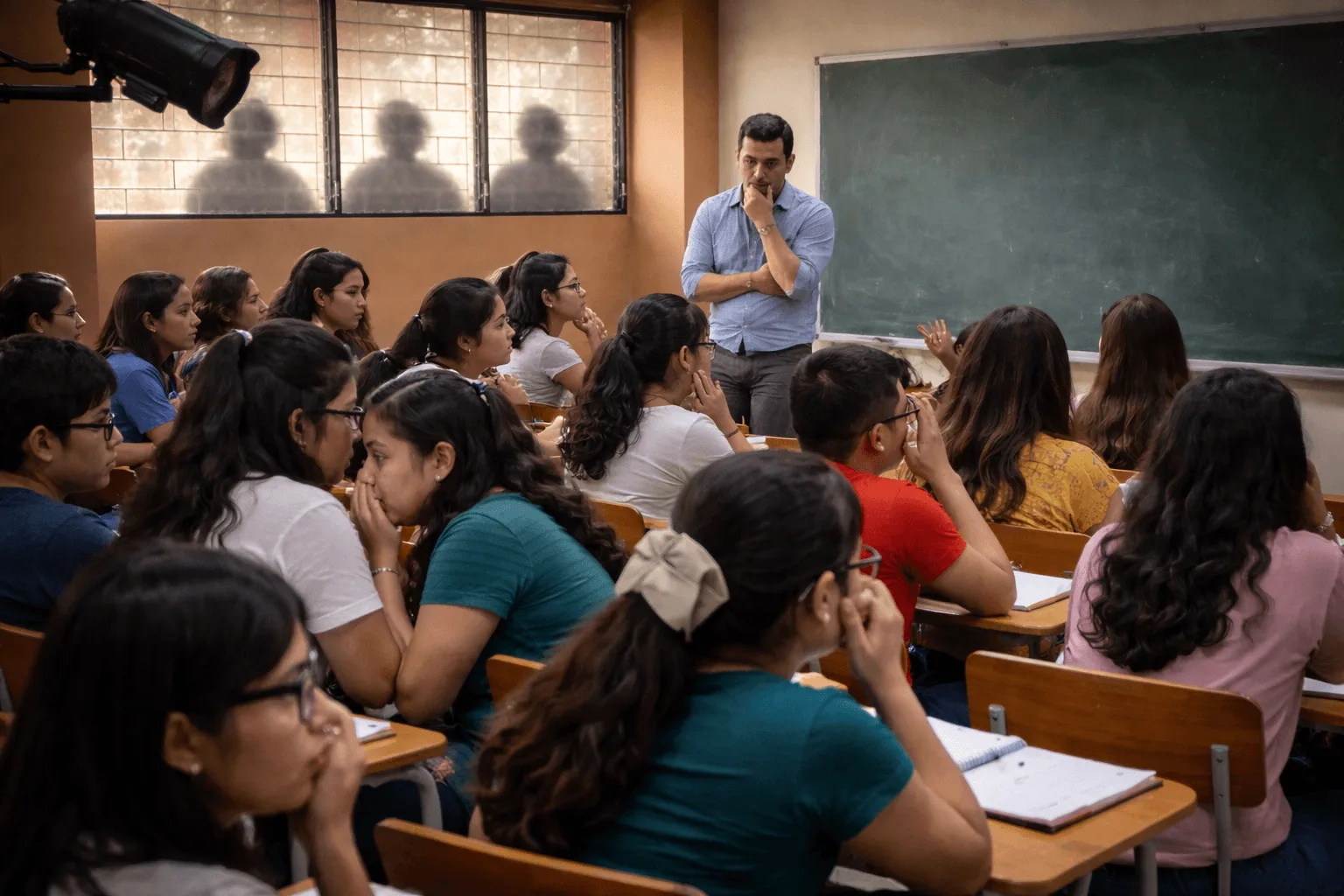
Students consulted describe a decline in classroom participation.
“There is fear of organizing or talking about politics. The dynamic has become going to university to listen, but not to debate,” explained a student, noting that the atmosphere has changed compared to previous years.
Warnings from international organizations
International organizations have issued warnings about the situation. Human Rights Watch has stated in recent reports that the state of exception has led to “arbitrary detentions and restrictions on civil liberties.”
Meanwhile, Amnesty International has documented a “climate of fear” affecting journalists, activists, and citizens critical of the government.
Statements on fundamental rights
Similarly, the Inter-American Commission on Human Rights has noted that the extension of exceptional measures can limit rights such as freedom of expression, association, and judicial guarantees.
According to the organization, these scenarios may translate into practical difficulties in the full exercise of citizens’ rights.
Self-censorship and preventive practices among professors
Within universities, this situation is reflected in practices of self-censorship. Professors avoid addressing sensitive topics related to security, public policy, or civil rights.
“Self-censorship does not always have a visible face,” said another professor, explaining that many decisions are made preventively due to potential consequences.
Allegations of internal reprisals
Some testimonies also mention alleged internal reprisals.
“There are authorities aligned with the regime. There is persecution within the university. I have been removed,” claimed a professor.
These statements have not been independently verified, but they reflect perceptions present in academic sectors.
Indirect pressures within the educational environment
Students also warn about indirect pressures within the educational environment.
“There are professors openly pro-government, and that limits what you can say. There is fear of reprisals, even in grading,” said a university student.
Decline in participation spaces
According to the collected testimonies, the impact goes beyond classrooms. Some professors have reportedly been removed from their positions due to critical stances, while student organization spaces have diminished or disappeared.
In this context, academic participation and deliberation are conditioned by the political environment.
Lack of academic protection policies
So far, there is no specific public policy in El Salvador aimed at protecting academic freedom in higher education institutions.
Meanwhile, international organizations continue monitoring the situation of fundamental rights in the country.