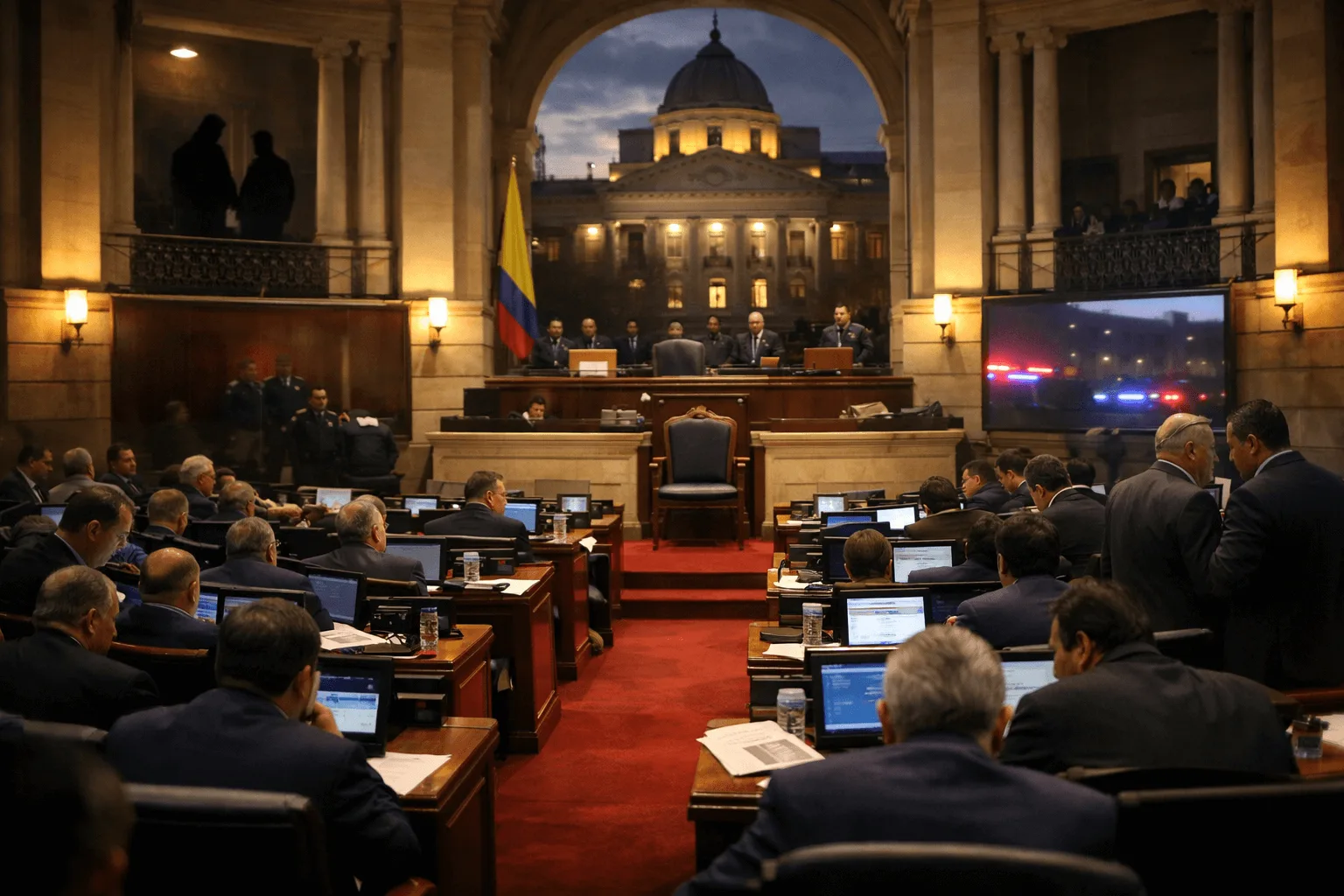
The loss of seats in Colombia’s Congress has become a warning sign about how private interests, regional political structures, and illegal networks have influenced legislative work, leading to judicial scandals, sanctions against lawmakers, and a direct impact on democratic representation.
Denied Rights in Latin America.
Various academic, judicial, and journalistic investigations have documented how private interests, regional political structures, and, in some cases, criminal organizations have directly influenced the actions of members of Congress in Colombia, affecting the right to political representation and equality before the law.
The hidden power of Congress: laws decided in the details
The analysis suggests that the real power of Congress does not lie solely in approving or rejecting major reforms, but in high-impact technical decisions, such as modifying articles, adding clauses, or introducing changes during legislative reconciliations. According to these studies, a single legal provision can represent economic benefits worth millions or even billions of pesos for specific sectors, raising concerns about the regulatory capture of legislative power.
You may be interested in: This is how political machines operate in Colombia: abstentionism that turns voting into power
The Constitution establishes that members of Congress must act in the public interest and uphold justice, and Law 5 of 1992 requires them to declare conflicts of interest and disclose economic ties and private activities. However, experts point out that these control mechanisms have not been sufficient. “On paper, there are tools to prevent the capture of Congress, but in practice the records are not easily accessible and citizen oversight is limited,” academic analyses of the legislative branch warn.
Loss of seats in Colombia’s Congress: when representation is nullified
One of the clearest indicators of this problem is the application of the “empty seat” rule. A study by political scientist Javier Duque Daza of Universidad del Valle documented that between 2010 and 2024, at least 18 cases were recorded in which members of Congress or political parties lost seats due to links with corruption or criminal structures. The researcher notes that these cases “demonstrate that democratic representation was nullified by actions that betrayed the citizens’ mandate.”
This situation is compounded by judicial processes related to the “parapolitics” scandal. The Observatory of Justice and Impunity found that between 2007 and 2018, the Supreme Court of Justice issued more than 60 rulings related to alliances between lawmakers and illegal armed groups, most of them convictions. According to these rulings, such alliances directly affected the right to free voting and political participation without coercion.
Public resources and political support under investigation
More recently, the Supreme Court has opened investigations against members of Congress for alleged irregularities in the processing of legislative reforms, within the framework of the scandal involving the National Unit for Disaster Risk Management. In these cases, authorities are investigating the possible use of misappropriated public resources to influence political support within Congress. “Funds intended to address emergencies may have been used to secure legislative backing,” judicial sources linked to the case stated.
Although the Office of the Inspector General and the Office of the Comptroller General have disciplinary and fiscal oversight over members of Congress, experts in institutional control warn that there is no consolidated and up-to-date public database showing how many legislators are under investigation for conflicts of interest or regulatory capture, limiting citizens’ access to information.
A crisis affecting trust and democratic rights
Studies agree that these practices affect fundamental rights such as equality before the law, effective political representation, and access to justice, while also weakening citizens’ trust in the State. According to researchers, when legislative activity responds to particular interests, the law ceases to fulfill its role as a general safeguard.
Academic and judicial investigations are ongoing, while authorities continue advancing disciplinary and criminal proceedings aimed at establishing individual and political responsibilities within the Congress of the Republic.